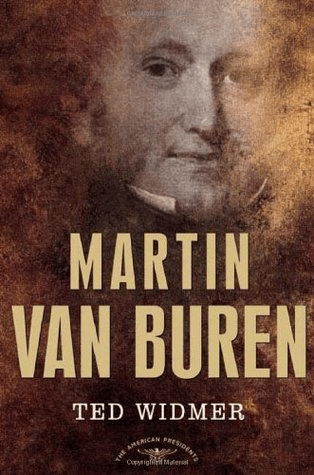
Martin Van Buren was the first president born in the United States after the Revolutionary War and also the first president from New York. He’s the only president who didn’t speak English as his native language (he grew up speaking Dutch). He’s one of the few presidents who wasn’t Anglo-Saxon, and one of the few who wasn’t either college-educated or a war hero. He was distantly related to Theodore and Franklin Roosevelt.
He was blond, and to compensate for his baldness, he grew ridiculously big sideburns. He was one of the shorter presidents at five feet, six inches. He was an optimist with a sunny disposition and was friends with the famous writer Washington Irving.
Van Buren was born in his father’s tavern in Kinderhook in 1782, a middle child with eight siblings. His father owned six slaves, but wasn’t particularly wealthy. Van Buren had to drop out of school at 13 due to his father’s lack of finances, but he became an apprentice to a lawyer and eventually studied with William Van Ness in New York City. (Van Ness was friends with Vice President Aaron Burr and was his second in the infamous duel with Hamilton.) Aaron Burr liked Van Buren and mentored him. The fact the two looked alike made some think Burr was his real father.
Van Buren became a successful lawyer and married Hannah Hoes, who was his first cousin once removed. (The Van Buren family tended to marry relatives.) We know less about her than other first ladies. No portrait of her exists. Van Buren doesn’t even mention her in his autobiography. She gave him four sons and died of tuberculosis before he became president. He never remarried, although there were rumors that he committed an indiscretion with Thomas Jefferson’s granddaughter Ellen Randolph.
In 1812, when he was just 29, he got elected to New York’s state senate as a Democratic-Republican. He passed legislation to help the war effort and rose in power. He was opposed to debtor’s prison, which earned him praise from the poet Ezra Pound. (The poet Walt Whitman also remembered Van Buren fondly.)
He became attorney general and helped found the Albany Argus newspaper. He supported the Erie Canal, which was the biggest public project of the era. He was elected to the US Senate in 1821 and started a new political party called the Democrats.
Virginia had once been the most populous and most wealthy state, however by 1820, New York had the highest population and was extremely wealthy, mostly thanks to the Erie Canal. As Virginia lost influence, it had to form an alliance with New York in order to keep slavery alive and Van Buren was happy to have southern allies.
During the presidency of John Quincy Adams, Van Buren’s Congress blocked nearly everything Adams tried to accomplish out of spite. (They thought Andrew Jackson should have won the election.) Van Buren campaigned for Jackson to get elected in the next election, forming secret alliances with journalists and politicians across the country, including Adams’ vice president. He also orchestrated what came to be known as the Tariff of Abominations which almost caused the Civil War to start early.
When Andrew Jackson was elected president, Van Buren was elected governor of New York, but he left the position almost immediately to become Jackson’s secretary of state. Jackson retained Adams’ vice president as his vice president, which is the only time this has ever happened. Van Buren became very close to the short-tempered Jackson who was also a fellow widower. As secretary of state, Van Buren got a favorable trade deal with the UK, got a large payment from France, and a treaty with the Ottoman Empire.
During Jackson’s presidency, his secretary of war married a women who he’d begun having a relationship with while she was still married to another man. The other cabinet wives snubbed her, as much because of her low upbringing as for the sexual indiscretion.
This infuriated Jackson who had married a woman who was still another man’s wife himself. Van Buren defended Peggy as well, perhaps because her father was a lowly tavern keeper like his own father was. In either case, the affair caused Vice President Calhoun to lose favor in Jackson’s eyes, making Van Buren more likely to be the next president.
Calhoun meanwhile was trying to organize secession of the southern and western states from the union. Jackson learned Calhoun had wanted to arrest him years earlier for his illegal raids into Florida. Calhoun’s newspaper attacked Van Buren and vice versa.
Jackson’s cabinet was deeply divided. To solve this, Van Buren resigned. This gave Jackson an opening to ask other cabinet members to resign. Jackson then appointed Van Buren minister to England. In England, he reconnected with his old friend Washington Irving who was secretary of the American legation. Calhoun blocked Van Buren’s appointment to England, but this backfired, since Van Buren returned home and was nominated to replace Calhoun as vice president.
A new political party called the Whigs was formed to oppose Jackson and Van Buren. Davy Crockett questioned Van Buren’s masculinity, calling him Aunt Matty and imagining him dressed up in corsets. A novel titled The Partisan Leader caricatured Van Buren as dainty and delicate.
But Van Buren had Jackson’s backing and easily won the presidential election. At 53, he was the youngest president up to that time. However, things turned bad after only his thirteenth day in office.
The Panic of 1837 was the worst financial catastrophe to hit the United States before 1929. Prices rose. Financial houses and banks closed. It also spread to financial institutions in Europe which were heavily invested in American businesses.
In 1835, New York was so prosperous it was second in the world only to London. New inventions like the railroad were bringing prosperity. Land sales skyrocketed. A huge number of shaky banks and middlemen came into existence to finance these land deals.
Jackson’s Specie Circular in 1836 forced land to be purchased in hard currency (not paper money) which caused people to distrust paper money and led to a gold shortage. Jackson also closed down the Bank of the US, which led to an increase in irresponsible speculation. Jackson certainly contributed to the Panic of 1837, but other factors contributed to it as well.
There was also too much loose credit and inflation, the economy was overextended through speculation, and there was an unfavorable balance of trade with England. Problems in the UK caused England to demand payments from American bankers who couldn’t get the money. At the same time, the price of cotton fell and other crop failures occurred. Once no credit was available, new businesses couldn’t be started. There were a record number of bankruptcies, massive unemployment, and many people died of starvation.
Van Buren was blamed and he began drinking a potion made of soot and water to ease his dyspepsia. To ease the financial crisis, he proposed the creation of the Treasury, the creation of Treasury notes to get more money into circulation, and he delayed lawsuits against banks to help them recover. However, the Treasury failed to get passed through Congress until 1840. Even when it was created, it did little good since the government couldn’t regulate Wall Street at the time.
Van Buren generally avoided the topic of slavery. He was a northerner, but needed southern votes, so it was best for him not to take a side. During the debate over Missouri entering the Union, Van Buren seemed to support the anti-slavery side, but in a non-committal way. He was too slavery friendly for many. He had been a former slave owner himself (he owned a single slave named Tom who had run away). His eldest son married the daughter of a plantation owner (the cousin of Dolley Madison) who served as White House hostess, giving White House parties a Southern feel. Van Buren also suppressed the spread of anti-slavery materials and supported the Gag Rule which prevented anti-slavery petitions from being talked about.
It was becoming more difficult for Americans to ignore the issue. England freed its slaves between 1833-1838. Mexico freed its slaves in 1829. The proliferation of printing presses and fast railroad transportation made it harder for politicians to say one thing to one crowd and the opposite to a different crowd. In 1837, an abolitionist printer named Elisha Lovejoy was brutally murdered by a pro-slavery mob. Van Buren continued being moderate on slavery at a time when he needed to pick a side. Both sides were suspicious of him. The slavery debate in Congress was so intense one representative killed another in a duel over it.
Van Buren delayed annexing Texas into the union. Adding a new slave state would enrage his supporters in the north, but delaying made the south hate him too. Van Buren enraged the south by allowing blacks to testify in a naval case, and he enraged the north by issuing an executive order to return the Amistad slaves to their masters (John Quincy Adams ended up winning the freedom of the Amistad slaves before the Supreme Court.)
Van Buren’s vice president Richard Mentor Johnson treated one of his slaves as his wife, seating her and their daughters at dinner with guests and traveling publicly together. He paid for his daughter’s education and his wife ran his estate in his absence. This state of affairs, of course, upset slave holders.
While president, Van Buren continued Jackson’s Indian removal program, including the Trail of Tears and the Seminole War. One of his nieces hoped he’d lose the election because of his ill treatment of the native Americans.
In 1837, a Canadian rebellion against Great Britain erupted. The British boarded an American vessel Caroline which had been supplying the Canadian rebels. One American died, although the rumor mill claimed the number of deaths was much higher. Van Buren cooled tensions and avoided escalating the conflict.
A year later, tensions rose again regarding the boundary between Maine and Canada. Van Buren again kept things from escalating. In 1841, Daniel Webster, then secretary of state, proposed a preemptive war against England.
In 1839, the phrase OK, short for oll korrect (a slang way of saying all right) began to circulate. Van Buren used it to mean Old Kinderhook and wrote OK next to his signature. The phrase is still used today due to him popularizing it. In 1840, Van Buren created a 10-hour workday, an improvement over the standard sunrise to sunset work day of the time.
The 1840 election pitted William Henry Harrison against Van Buren. Because Van Buren had made much needed improvements to the White House, he was caricatured as a big spender on luxury items. Whigs claimed Harrison had humble beginnings growing up in a log cabin, when he actually grew up in a mansion that was much fancier than the tavern Van Buren was raised in.
Van Buren lost the election and retired to be a farmer for a bit. He then took a tour of the country. Poor roads forced him to stop in Rochester, Illinois where he met young Abraham Lincoln who told so many funny stories, Van Buren’s sides hurt from laughing. He said he’d never spent a more agreeable night in his life.
Van Buren ran for president again in 1844 after drumming up support during his tour of the country. He was the favorite candidate until he came out boldly against annexing Texas, which made the South hate him. He had the majority of delegates in the Democratic convention, but not the required two thirds. Polk ended up winning the nomination and Van Buren campaigned for him, helping him win New York. Van Buren expected Polk would reward him, but Polk ignored Van Buren’s cabinet recommendations.
In 1848, Van Buren wrote the Barnburner Manifesto, a firmly anti-slavery tract and ran for president again with a new Free Soil party with John Quincy Adams’ son Charles Francis Adams as his vice presidential running mate. He didn’t win, but his third party drew enough votes away from Cass to make Zachary Taylor the winner.
After losing again, he came back into the Democratic fold, even though it was still partly pro-slavery. One of his sons moved in with him along with his children. He traveled Europe with a different son who hoped a more favorable climate would improve his failing health and began writing his memoirs.
When the Civil War came, Van Buren supported Lincoln. He died the day after Lincoln read the Emancipation Proclamation.
Van Buren is often ranked as an average or below average president, however, I think he should be ranked above average. While he was responsible for a lot of deaths (he continued Jackson’s Trail of Tears and Second Seminole War), he saved tens of thousands of lives by avoiding a war with Mexico over the annexation of Texas, and he saved thousands more by avoiding war with England over Canadian disputes.
 Mania Delight