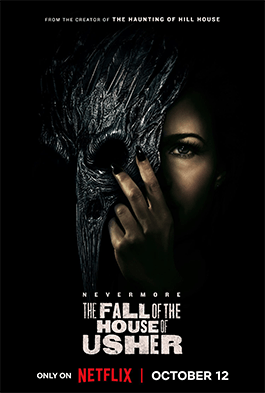
The Fall of the House of Usher completely retells some of Poe’s most famous stories and contains numerous easter eggs referencing his writing and his life, sometimes directly quoting from him. Vulture has a list of many of these references, although they did miss the reference to Toby Dammit from “Never Bet the Devil Your Head” and a character wrapped up like a mummy being a reference to Poe’s story “Some Words with a Mummy”. Also, they miss the fact that several of Poe’s humorous stories involve making a deal with the devil.
In the show, the Usher family is responsible for the opioid crisis, making the entire series seem like a criticism of the real-life Sackler family. The fact that some of Poe’s characters (such as the narrator of “Ligeia”) are opium addicts does make the opioid crisis a suitable theme for a Poe adaptation.
Mark Hamill plays the family lawyer, Arthur Gordon Pym. We don’t see his famous arctic expedition, although it is referred to. Poe’s famous detective, C. Auguste Dupin, is the district attorney prosecuting the Usher family. It would have made sense to make him a detective, but we at least see him use his detective skills to determine a young Roderick and his wife Annabel Lee stayed up all night with a sick child just by looking around their apartment.
There’s a lot of great speeches. Some of them quote Poe and some seem to be original to the show. As you’d expect, people die in a variety of gruesome ways. People are buried alive in many of Poe’s stories, and this show does feature such a scene. One of Poe’s major topics not covered in the series is mesmerism, but I guess they couldn’t fit everything in. While there are references to Poe’s humorous stories, it would have been nice for the series to add some of Poe’s dark humor.
Since it’s revealed in the opening of the first episode, it’s not a spoiler to say all six of Roderick Usher’s children die and the series mainly focuses on how these deaths occur. Those familar with Edgar Allan Poe’s stories can guess what the general outline of their stories will be from the episode titles, but the stories do get changed up quite a bit.
I didn’t care much for Masque of the Red Death (episode 2). The death scene was disgusting rather than frightening. The episode itself features a lot of sex, nudity, and foul language. It seemed to focus more on shock value than being scary.
Murder in the Rue Morgue (episode 3) was much better. For me, it was the scariest episode. The final scene gave me chills. Like all of the episodes, it’s quite a bit different from Poe’s story, but incorporates imagery from his story in an effective way.
I didn’t think the CGI cat in The Black Cat (episode 4) was as impressive as the CGI chimpanzee in the previous episode. Also, The Black Cat felt too similar to The Tell-Tale Heart (episode 5). To be fair, the two Poe stories are similar to each other, but having these two stories back to back causes The Black Cat to pale in comparison. The Tell-Tale Heart is a stand out episode which improves upon the original Poe story, making it even more messed up than the original.
Goldbug (episode 6) didn’t appear to have anything to do with Poe’s treasure hunting story other than the name of the episode. It resembles the Poe story “William Wilson” more than anything else, however the character named Bill Wilson isn’t the one with the doppelganger. The death scene in this one was quite visceral. The fact is was in slow-motion made me feel squeamish.
The Pit and the Pendulum (episode 7) also incorporates story elements from the Poe story “Berenice”. The Raven (episode 8) contains a moving rendition of Poe’s famous poem, as well as incorporating plot points from “The Cask of Amontillado” and, of course, “The Fall of the House of Usher”.
With one exception, Verna (whose name is an anagram of raven) seems happy to kill people and she isn’t too concerned about collateral damage. With one exception, we’re shown all the people she kills are horrible people, so we aren’t meant to sympathize with them. The children don’t even mourn each other’s deaths.
The Fall of the House of Usher has a lot of scary moments and is a loving tribute to Edgar Allan Poe, but it also has a lot to say about the ethics of big businesses in general, and pharmaceutical companies in particular. There’s definitely a “rich people are horrible” theme to the show. The Raven mentions Donald Trump is one of her clients and we see her with many other real-life rich people such as the Koch family, Mark Zuckerberg, Mitch McConnell, Rupert Murdoch, and Brett Kavanaugh who presumably have made similar deals with her as Usher did. Leah Schnelbach at Tor.com mentions that all the Usher family seem to be afraid of death and try to make themselves immortal in different ways: using AI, company legacy, family legacy, health products, etc.
I love Verna’s speech which points out that humans have enough money to eliminate poverty, but instead we spend money on luxury goods, things like the billionaire space race, etc. The show criticizes the rich, but it also criticizes the rest of us for buying clothing produced in sweat shops, asking for miracle drugs, and allowing marketing to manipulate us. Verna also mentions that poverty could be eliminated by not creating new movies or TV shows for a year. This seems to be Mike Flanagan criticizing himself. In the end, the show tells us wealth leaves you morally impoverished and true wealth is found in having a happy family life.
Another theme is children being punished for their parent’s sins. Interestingly, this is also a theme in the new Goosebumps show on Disney. I think this is becoming a more common theme in TV due to global warming and the many other ways people value short term benefits over the long term our children and grandchildren will have to live with.
Strangely, another major theme is the Mother Theresa quote that pain and suffering are the kisses of Jesus. After watching his mother suffer, Roderick Usher wants to eliminate pain, but that’s a bad thing because it leads to the opioid crisis. This show wants to tell us that pain is good. In fact, at the end of the show, we’re told two of the surviving characters have to go through years of pain to recover, something Mother Teresa would have approved of. The bad guys get off relatively easy by dying relatively quick deaths, while the not-so-bad characters have to endure years of kisses from Jesus. According to Poe’s story “Mesmeric Revelation”, pain is necessary to appreciate pleasure, so this theme is also present in Poe.
I think Kirk said it best in Star Trek V: “Damn it, Bones, you’re a doctor. You know that pain and guilt can’t be taken away with a wave of a magic wand. They’re the things we carry with us, the things that make us who we are. If we lose them, we lose ourselves. I don’t want my pain taken away. I need my pain.”
 Mania Delight