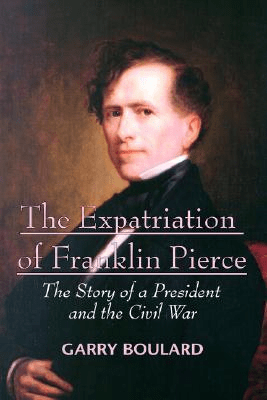
Benjamin Pierce fought in the Revolutionary War, was a sheriff, state legislator, and a local hero. However, his lack of education made him hesitate from a life of politics. He encouraged his son Franklin to be a politician. At 14, Franklin Pierce was sent to boarding school, then to Bowdoin College two years after that.
He wasn’t enthusiastic about school and came in dead last on the list of student standings his first year. He determined to do better. During the summer he made some money teaching. When he returned to college, he formed a marching unit. Younger students Nathaniel Hawthorne and Henry Wadsworth Longfellow drilled under his command and became friends with him.
By the end of his final year, he graduated third best in his class. His father then arranged for him to become a postmaster. Pierce then studied law under a series of judges while his father was elected governor in 1827.
In 1829, Franklin Pierce was elected to state legislature. Two years later, he was named Speaker. A year later, he was elected to the US House twice as one of the youngest members of Congress. He then became a senator in 1836 at only 32 years old. He was respected and admired by even his foes.
There were rumors of his drinking. He and a couple other congressmen were involved in a drunken brawl at a Washington theater. Pierce suffered from bronchitis throughout his life, an ailment that was made worse when he drank.
He got married late for the time period. (He was 30 and his wife was 28.) His wife, Jane Means Appleton, was the daughter of a reverend who died young. She was pious, read novels, played the piano, and rode horses. He wasn’t as religious as her, but he loved her. Their first son died shortly after birth. Their second son died at the age of four.
Washington life was hard on Jane. Pierce promised his wife he’d stop drinking and would leave politics to instead practice law. His friends didn’t think he was serious and tried to get him interested in several public offices. He even turned down President Polk’s offer of US attorney general. He said the only thing that would separate him from his family was war.
Polk declared war on Mexico shortly after and Pierce volunteered to join. Pierce admired Andrew Jackson and wanted to be a military man himself. He served for six months as a brigadier general, but missed out on battle due to bad luck. His horse fell on a ledge and Pierce twisted his left knee. He rallied to fight the next day, but the pain from his injured knee caused him to faint. When he later ran for president, this incident was used to accuse him of cowardice.
Pierce was opposed to slavery, but he was also opposed to the abolitionist movement as it would force the South to secede from the Union. Born and raised in New Hampshire, Pierce had never seen a slave until he moved to Washington. Slavery was an abstraction to him, so it was easy for him to ignore the brutality of it.
In later years, Pierce’s allies disagreed over how involved he was in seeking the presidency in 1852. Some said he was a true dark horse candidate who showed interest in being elected only as a symbolic gesture and didn’t actually expect to win. Others said he manipulated everything behind the scenes from the start, which would have been out-of-character for him. In either case, he broke his promise to his wife not to get involved in politics again, putting her delicate health at risk. When she heard he’d gotten the nomination, she passed out.
Most people didn’t know who Pierce was when he got the Democratic nomination for president, but his presidential campaign focused on his good looks, putting portraits of him on medallions, medals, and handkerchiefs. Dubbed “Young Hickory” and presented as a woodsman, he was actually a man of refined tastes who read the Greek classics and enjoyed expensive wine. A popular slogan was the Democrats “will pierce their enemies in 1852 as they poked them in 1844.” His opponents called him a drunk and a coward. “The hero of many a well-fought bottle.” Pierce ended up winning in a landslide with the largest popular vote up to that time in history (although voter turnout was also at its lowest level since 1836). He was the youngest man to be elected president at the time.
The last of his three sons, Bennie, died at the age of 11 in a train accident weeks before Franklin became president as the Pierces were returning from a funeral. Pierce and his wife sat together with Bennie in the seat behind them. The train car fell off the embankment and broke into pieces. Most people weren’t seriously hurt, but Bennie’s skull was crushed and his head was partially severed. That night, the Pierces stayed at an empty farmhouse alone with their son’s body. Returning to Bennie’s empty room when they got home, his mother wrote him a letter expressing regret for anything unreasonable or mistaken she might have done in her conduct towards him. She avoided social functions for the first year of her husband’s presidency. She doted over Jefferson Davis’s son Samuel, until he too died of illness before he was two years old.
Pierce affirmed his oath of office on a law book rather than the Bible (John Quincy Adams also swore on a book of law). To avoid the thousands of office-seekers, Pierce didn’t go to Washington right away, but the office-seekers came to his home in Concord. Despite the distraction, he put together a geographically-diverse cabinet from competing factions of his party. It was the only cabinet in history to remain intact through a presidential term of office. Jefferson Davis was perhaps his closest friend and his secretary of war. He convinced Buchanan to be ambassador to Britain even though he didn’t want the job. He appointed his friend Nathanial Hawthorne to the US consul in Liverpool.
Pierce considered the White House the people’s house and let anyone take a tour. He renovated the White House and its gardens, added a new green house, and installed a hot-water heating system. He treated his servants and regular citizens with as much courtesy and respect as generals and dignitaries. The press loved him at first.
He had blue eyes and preferred to dress in black. He sometimes wore a black velvet dressing gown while receiving dignitaries. He would walk around Washington by himself without servants. While president, he longed for comfort and privacy and sometimes snuck away to relax at a friend’s house.
Pierce and Davis sent survey teams to map out the future transcontinental railroad, added additional land to New Mexico and Arizona with the Gadsen Purchase, and tried unsuccessfully to acquire Cuba. He wanted to annex Cuba, either by purchasing it or by invading it, but popular opinion was against him, so he abandoned his plans.
He took a tour of the East Coast where he drank freely, breaking another of his promises to his wife. He drank so much, reporters noticed he was suffering from a hangover when he arrived in New York. At the grand opening of the Crystal Palace in New York, the crowd expected him to ride in a carriage, but instead he rode on horseback to the delight of the onlookers. When it began to rain, he refused an umbrella, saying, “I am not sugar! I shall not melt!”
Pierce remained mostly popular until 1854 when a bill called for the creation of the Kansas and Nebraska territories without forbidding slavery in the new territories, ignoring the Missouri Compromise. Pierce lobbied for the passage of the bill and signed it into law. This ignited the abolitionist movement. It caused abolitionist Democrats to switch over to the Republican party. People started snubbing Pierce. When they saw him in public, they’d pretend they didn’t see him. He immediately became hated by a large portion of the population.
The night the bill was passed, an escaped slave named Anthony Burns was caught in Boston, the center of the abolitionist movement. A crowd stormed the courthouse with a battering ram to free Burns. In the ensuing melee, a guard was killed. Pierce sent in troops to restore order and Burns was returned to his owner in Virginia, making Pierce even more unpopular.
In Congress, tensions were high over slavery. A pro-slavery representative from South Carolina beat Senator Charles Sumner nearly to death with a cane on the Senate floor, partially paralyzing him. In Kansas, hundreds had died in the fight over slavery and many thought Pierce was pro-slavery because of his friendship with Jefferson Davis.
In the midterm elections, the Democrats lost big in the northern states. Pierce had become unpopular in the southern states as well because they blamed him for turning northern sentiment against them. He was not re-elected. He was only 54.
Pierce was considered the most hated man in America at the end of his presidency. In the election, he’d been defeated by his own party, his own state, and possibly his own town. His former friend John Hale called him reprehensible. George Kittredge said Pierce “has the damnest black heart that was ever placed in a mortal bosom” and “in hell, they’ll roast him like a herring.” Sam Houston said “He is the traitor of all ages” and “betrayed more pledges and deceived more men than any other man that has lived.” Emerson hated him. Walt Whitman said he “eats dirt and excrement for his daily meals, likes it and tries to force it on the states.”
James Gordon Bennett, owner of the New York Herald, had supported Pierce when he was running for president and expected to be named ambassador to France in return. When Pierce didn’t comply, he started a smear campaign against the president. Many other newspapers hated him by the end of his presidency as well.
For Buchanan’s inauguration, the chief of police promised to round up all the hogs and geese running at large in the city. Five months after Buchanan took office, the Ohio Life Insurance Company failed, triggering bank runs and a recession that would last all of Buchanan’s term. The violence in Kansas continued. Pierce and his wife, meanwhile, had set sail for a European tour. He met with his old friend Hawthorne in Rome during the jaunt. Buchanan had become unpopular by the end of his term and people were talking of Pierce running again in 1860.
Upon his return to the US, Pierce began a speaking tour. He gained popularity and seemed a good choice for the Democratic nomination for 1860. As an anti-abolitionist Northerner, he had a lot of support in the South. However, Pierce didn’t want to run.
Lincoln won the election and the Confederate rebels began their attack against the United States before he even took office. The majority of southerners were against secession, but the delegates at the special conventions voted to secede, dragging the country into war.
Pierce blamed the war on the abolitionists. His friend Jefferson Davis became president of the Confederacy and ex-President John Tyler also joined the Confederates. Pierce called for peace between the two sides.
When Lincoln suspended habeas corpus and shut down newspapers critical of him, Pierce was outraged, although his wife Jane, who had long been opposed to slavery, was on Lincoln’s side. Pierce traveled to Michigan, Indiana, and Kentucky where he met with fellow anti-Lincoln Democrats. Rumors spread that he was planning treason and was part of the pro-Confederate Knights of the Golden Circle, a secret society which probably didn’t even exist.
A supporter of Pierce named Dr. Guy Hopkins wrote a letter tying Pierce to the Golden Circle as a practical joke meant to expose how gullible the press was. Secretary of State Seward took the letter seriously, although Lincoln laughed it off. Hopkins was arrested and Seward wrote an accusatory letter to Pierce. Pierce gave an insulted reply and Seward backed down, claiming an underling had written the disrespectful letter. Hopkins was released a while later. Pierce thought the issue was ended, but newspapers resurrected the charges against him, so he made his correspondence with Seward public and finally put the rumors to rest.
Nathanial Hawthorne was critical of abolitionists and Lincoln. He didn’t think the Civil War was worth fighting. He decided to dedicate his book Our Old Home to Franklin Pierce, despite objections from his publisher, fellow writers, and family. The decision cost him sales. He called Pierce “the only loyal man in the country.” Emerson cut out the dedication from his copy of the book.
Pierce continued to make speeches criticizing Lincoln for suspending habeas corpus. He accused the North of being in the wrong and called for peace. He received a lot of hateful responses from the newspapers.
Jefferson Davis wanted to be a military leader, but was made president of the Confederacy instead. His political skills weren’t great. Also, as the Confederacy was a new government, it had no existing bureaucracy or institutional memory. He faced a difficult task since the North was more populous, more rich and powerful, able to recruit more soldiers, produced more war supplies, and had far better supply lines due to railroads twice as large as those in the South.
Also, the Confederate constitution emphasized state rights, which greatly hampered the war effort. Governors would refuse to submit to the centralized authority. States would build up their own militias instead of contributing soldiers to the Confederate army. Southern newspapers criticized Davis as much as Northern newspapers criticized Lincoln. His decisions were constantly being questioned and ridiculed. Some of his top generals openly complained about him.
When Davis’s plantation was captured by US troops, letters that Pierce had written to Davis before the war broke out were discovered. The most recent was published in a newspaper. In the letter, Pierce said if a war were to break out, it would be because of the madness of abolitionists and thought the North would be divided between abolitionists and those Northerners who supported the South. Many newspapers accused Pierce of treason.
Soon after this, his wife Jane died and his friend Hawthorne became ill. He and Hawthorne traveled to Plymouth and stayed at an inn. Pierce checked on his ill friend during the night and discovered he was dead.
Not wanting to run against Lincoln in 1864, Pierce declined his party’s nomination for president. Establishing that he was still firmly anti-Lincoln, he remarked that he hoped the upcoming election wouldn’t be held at bayonet point, infuriating Lincoln’s supporters. He further commented that the war could be ended if Lincoln would just negotiate, the same thing Confederates were saying, leading some to suspect he was in secret communication with them.
Lincoln got reelected by a large margin, largely thanks to the war going well. The Civil War ended and Lincoln was assassinated. Secretary of State Seward was also assassinated. People were outraged. When a soldier in Florida remarked he was glad the president was dead, his fellow soldiers hung him. Anti-Lincoln newspapers were ransacked. One editor was killed for running an article critical of the deceased president. Judges sentenced men who expressed pleasure at Lincoln’s death to six months in prison for inciting a riot. Four people found guilty of being co-conspirators with Booth were sentenced to death by hanging, including one woman, which outraged many.
Since Pierce was Lincoln’s enemy in life, he once again became quite unpopular. As his house wasn’t decorated with an American flag or black bunting (a sign of mourning for the fallen president), hundreds of boys marched to his house, demanding that he hang out a flag. Pierce came outside and gave a speech, telling the audience he was sorrowful at Lincoln’s death. If they doubted his patriotism despite his record, hanging a flag now wouldn’t change anything.
In 1865, Pierce got baptized into the Episcopal Church. He hadn’t been particularly religious before because so many preachers lectured him on the evils of slavery, but he found a religious leader who accepted him despite his stance on slavery.
Pierce visited his friend Jefferson Davis in jail and offered legal advice. Davis fell ill and President Johnson decided to release him from prison. If he died in prison, it would make him a martyr for the Confederacy. The charges of conspiring with Booth were dropped, however, he still faced charges of treason. However, Davis was never put on trial because Johnson declared amnesty for all Confederate leaders as he was leaving office.
Pierce died of an illness his doctor called “abdominal dropsy” (cirrhosis caused by his life-long heavy drinking). Some mourned his passing, but many newspapers still despised him. The New York Herald still referred to him as Poor Pierce.
Pierce is largely considered one of the worst presidents. Garry Boulard does the best job he can of trying to rehabilitate his image. However, it seems the only way to make Pierce look good is to make the abolitionists look bad. While Lincoln and the abolitionists certainly did some bad things, they at least opposed slavery, while Pierce provided support to the slave holders. No amount of spin can change that.
As I’ve been reading presidential biographies, I’ve been ranking presidents based on how many lives were saved or lost due to their actions.
British consuls tried to enlist Americans to fight in the Crimean War in 1854. Pierce insisted on remaining neutral and expelled the consuls. It’s unlikely America would have joined the war, but if we’re feeling generous, we could say Pierce saved thousands of lives by this action.
On the other hand, over 100 people died in the fighting between the pro-slave and anti-slave factions in Kansas and Pierce was largely responsible. First, he ignored the Missouri Compromise which said states above a certain latitude should be free. Second, when Kansas voted on whether to allow slavery, Pierce ignored the fact that people from slave states crossed the border to vote even though they didn’t live in Kansas. Third, he not only accepted the illegitimate vote, but sent in federal troops to break up the government formed by the anti-slave faction. Pierce’s main legacy as president is all the deaths that happened in Bleeding Kansas.
 Mania Delight