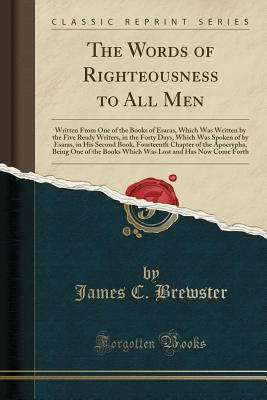
The full title of this book written by James C. Brewster is “The Words of Righteousness to All Men, Written from One of the Books of Esaras, [Esdras] Which Was Written by the Five Ready Writers, In Forty Days, Which Was Spoken of by Esaras, in His Second Book, Fourteenth Chapter of the Apocrypha, Being one of the Books Which Was Lost, and Has Now Come Forth, by the Gift of God, In the Last Days”.
At the age of 10, Brewster claimed to have been visited by the same Angel Moroni who had visited Joseph Smith. He was disfellowshipped from the mainstream Mormon church a year later. In the Preface, he claims to have begun writing this book in 1838 when he would have been about 12. This book was published in 1842 when he was about 16, which is quite impressive (although Joseph Smith wasn’t impressed). When Smith died two years later, Brewster began to accumulate followers and cofounded the Church of Christ (known as the Brewsterites) four years after that.
He received a revelation that there was a promised land called Bashan in the Rio Grande Valley and took a wagon train out west to find it. There were disagreements amongst his followers during the journey. Olive Oatman’s family was one of the groups that abandoned him. He seems to have stopped receiving revelations at that point and his church disappeared. He lived for six decades afterward, serving in the Union army during the Civil War (which left him with a lifelong disability), teaching African Americans at a school during Reconstruction, and working various odd jobs such as being a hack driver and an office boy.
Regarding the title of this book, God commands Esdras/Ezra (who Brewster calls Esaras) to leave town for 40 days and provides him with five writers in 2 Esdras 14. The five men took turns writing dictation using characters they didn’t know. During the 40 days, 94 books were written. God tells Ezra to make the 24 first books public, but the 70 written last should should only be shown to the wise.
In the Preface to The Words of Righteousness to All Men, Brewster tells us this is only an abridgement of the first, second, third, fourth, sixth, seventh, and eighth books of Esdras. (Why not the fifth? Also, according to the title of this book, it comes from only one of the books of Esaras. What’s up with that?) He says he’ll try to recover more lost books like this one, though he never did. He also says if the wise and learned men discover any mistakes, they are the mistakes of the scribe, for he diligently gave it word for word as it is in the original. (Way to throw the scribe under the bus.)
Chapter and verse numbers aren’t always provided, and when they are, they’re confusing. The first six paragraphs are unnumbered, the seventh paragraph is titled Chapter 7, the 21st paragraph is titled Chapter 75, a few paragraphs later we get Chapter 108, and a few paragraphs after that, there’s a section titled The Happiness of The Saints. He does say this is an abridgement in his Preface, so I guess we’re getting extracts from various books (even though the title of the book says this is just one of the books that was lost). He doesn’t always tell us the titles of the books we’re getting extracts from. To help keep things straight, I’ll provide numbers to the unnumbered paragraphs. When he provides a chapter or verse number, I’ll put it in bold.
The Words of Righteousness to All Men
1
“In the twenty-fourth day of the second month, I, Esaras wrote this book, which is the Words of Righteousness to All Men.” (I don’t think ancient scriptures usually state the title and publication date of their books, although he leaves off the year, so the publication date isn’t very helpful.) The Lord has created plants and animals for man, yet man still won’t obey the Lord’s commandments. In the last days, every nation shall be shaken and many shall fall to rise no more. Famine, pestilence, and earthquakes shall destroy many. All who will not serve the Lord shall be destroyed. Those who serve will be preserved like Emen (who?) and Noah were. Every man will be afraid of his neighbor.
2
As “the children of Israel were delivered from the armies of Pharoah, and Mecanist (who?) escaped over the mountains from those who sough to destroy him,” it shall come to pass that anyone the Lord doesn’t preserve shall be destroyed. Plants and animals will be destroyed because of man’s wickedness.
3-4
The destruction of the wicked is coming soon. (Wait, if Esaras is living back in Old Testament times and said the end was coming “soon”, doesn’t that make this a false prophecy? I guess he knew this book would be kept secret until the actual end times.)
5
Esaras tells us the words the angel told him, which is more of the same death to the wicked and the righteous being saved that he’s already told us about. The birds and beasts praise the Lord more than men do. Just as the Lord sent angels to carry Emen and his brethren away from the armies of Gitron, he will also send angels to you if you obey him. Many saints shall be slain, but they’ll dwell with the Lord. A city will be built on Mount Zion that will not be thrown down or destroyed. In those days, the rich man shall be cast down.
The words of the angel are ended, but Esaras gives us more death and destruction. Don’t bow down to graven images, but rather to him who sendeth the rain upon your fields. Seems to take a page from the Book of Job and asks “Is there any one that can make the rain to cease from falling on the earth, or the storm to cease at his command?” He even mentions leviathan: “Is not the lion fierce, and the whale strong? Doth not the leviathan play in the waters of the great deep? And when the king of all beasts roareth the lion doth fear and tremble.”
6
More of the same.
Chapter 7
The Lord sends rain upon the fields of the wicked and righteous alike and sends prophets to the wicked, but they still won’t repent. The wicked kill people because there is evil in their hearts. Esaras refers to “our Saviour, Jesus Christ” which is anachronistic for the Apocrypha, but, of course, the Book of Mormon commits this same anachronism.
The blessings which the Lord shall pour out upon his saints, in the last days, shall be very great; they shall prophecy and speak with many tongues, and upon many the Lord will pour out his spirit in such a manner that the fire shall not hurt them, and that they shall not drown when they are cast into the water, they shall escape over the mountains like the fox, and they shall escape from their enemies, and no one shall find them.
– The Words of Righteousness to All Men, paragraph 8
8
The enemy of all righteousness will slay the saints, “but the Lord will stay his hand that he shall not have power over the saints.” The enemy will “lay waste the land from Kmolen to Shemolen.” (Now you’re just making up words.) Apparently, the Lord doesn’t want the enemy to have all the fun, for he joins in: “serve the Lord, for if you do not, he will suffer the firey [sic] flying serpent to be sent forth upon the earth, and the lion and the wild beasts shall follow behind and devour the carcasses.”
9
Again, we’re told the Lord will destroy the wicked and bless the righteous. (He’s using both the carrot and the stick approach, you see.)
10
In the days of Solmonto, who dwelt in the valley Simminto, the Lord punished the wicked with scorpions, but spared the rest “because of their righteousness-sake.”
11
After the earth is cleansed from evil, the saints will go forth over the whole earth and shall dwell upon it a thousand years. The enemy has made gold and silver, which was created for men, into an abomination in the sight of the Lord. And they have destroyed the fishes for naught. “The Lord will preserve the gold and silver and the most precious of all fish.” (Gold and silver I understand, but what’s with the fish?)
The Lord will send a scourge upon the earth never before heard of by man. It will ride in the air as the clouds, and (suddenly switching to plural) “they walk like men, yet they seem to fly like birds from before the face of their enemies; they shall sting as the scorpions and bite as snakes, they shall bite and devour and none shall stand before them, and by man they shall be called firey [sic] flying serpents, sent forth by the enemy of righteousness, the same is the Devil, to destroy men.” (Sounds similar to the locusts in the Book of Revelation.)
12
“Yet will he destroy the wicked and ungody from off the face of the earth.” Are we still talking about the Devil, or does the pronoun “he” now refer to the Lord? The riches of earth are not equal to the riches of the Lord’s glory, for thus the God of glory and truth has spoken these things unto the prophet Abinada. (You all remember Abinada, don’t you?)
13
Jesus Christ died for you. You must keep these commandments: “Love your neighbor as yourself, keep yourself humble as it were in the dust, be not lifted up in pride and do not esteem yourself better than your neighbor, despise not wisdom, but hold fast upon all holy wisdom, seek not to murder, neither shall thou steal.” (I like this list better than the original ten commandments which assumes we’re all slave-holders.)
14
In the last days, there will be great destruction… wait I’m getting déjà vu all over again. At least this part, in the middle of an epic page-long run-on sentence, is new: “when the ships of Tarshish and the ships of the East shall go to gather the saints to their homes, then shall the saints rejoice” however “when the waves shall overflow them, yea they shall even rejoice in death and praise the Lord that they can die in doing good.” How is being shipwrecked dying by doing good?
15
This comes out of nowhere and doesn’t get explained later: “But if you will do wickedly you must be destroyed, for God has created the mountains and formed the valleys, but he has not cast them high into the air, neither has he sunk the vallies [sic] deep in the depth of the earth, but he has suffered the enemy of all righteousness to do this because of the transgressions, and wickedness of man.” Huh? So, because of transgressions, God let the Devil make the mountains higher and valleys deeper?
16
“Jesus Christ shall shine forth upon the earth seven times brighter than the morning sun.” Everything that’s not part of the gospel of Jesus Christ is evil. Men think evil is good and good is evil because they don’t have the spirit of God to guide them.
17
“For the Lord shall come out in his fury and shall sweep off the nations from Dan unto the islands of the sea of Sheba, which lieth beyond the great river Euphrates.” More destruction talk. “For in the beginning of the thousand two hundred and ninety and ninth day (is this supposed to happen during the Middle Ages?) shall a king arise, and these days shall commence in the four hundreth and third from this time, and this king shall say I am strong […] but he shall fall in time of peace, when he supposes all is well, but the Lord shall send his destroying angel, then shall arise another king in his estate and he shall be proud and haughty […] he shall conquer three nations, then he shall be slain by the hand of an enemy […] and he who slew him shall wax strong and be mighty, and he shall vex the saints, such as are called saints but do not serve the Lord […] and shall provoke them to anger, and they shall take up sword against him, and an exceeding sore and dreadful war shall take place, and many of those who are called saints shall forsake the right way and shall become as wicked as those who persecuted them […] until the saints are all slain which have forsaken the right way.”
“And then shall they set up the abomination to divide all the earth and they shall reign over three parts of the earth for a season and a time and a half of the fourth part of the earth shall also be theirs but they shall not possess it long, but they shall possess it twelve days, which is twelve years, even so it shall be.” He then digresses to let us know any time the book mentions days, it really means years.
One king will reign over fifteen kingdoms, and Persia and Tubal shall be trodden under foot by the King. They’ll be so many horsemen, they shall dry up the brooks of Kidron. The waters of the brook shall not flow until they have passed by for nothing can stand before them besides the saints of the Most High. The Lord will destroy them and peace shall be restored.
18
The river will return to the ancient places and will be very beautiful as before the flood. In the last days, ships will sail on the waters “yet it shall not be to do evil, but it shall be to do good” i.e., ships will bring pine, fir, and cedar to Mount Zion and will bring gold and precious stones to Jerusalem. The islands will flee away and be joined together. The water will be pure. Rocks not for the use of men will return to dust (Satan must have created these non-useful rocks because why would God have created them?), while rocks which are for the use of men, such as jesamine and marble, will remain. Flowers not known of by men will return and make things beautiful.
19
If you praise God, he’ll bless you.
20
In the last days, great armies shall encamp around Jerusalem and the Lord will slay them.
The 21st paragraph is titled Chapter 75, so I guess we’re jumping ahead in the abridgement. The first paragraph of Chapter 75 is unnumbered and says only: “The days of my people saith the Lord shall be few, and full of sorrow.” How’s that for a recruitment pitch? The next five paragraphs are given verse numbers.
75:1
The angel tells Esaras that in 1,997 days (years) wickedness will be taken from the earth and in 1,949 days (years) the kingdom of God will be set up on the earth. (Esdras is traditionally dated to the 5th century BC, but scholars think it was actually written in the 2nd century BC. Per the title of his book, I think Brewster intended the end times to occur in his near future. I think the date the kingdom of God is set up would either refer to the founding of Mormonism by Joseph Smith or the founding of his schismatic church. In either case, the end times should have occurred in the late 1800s.)
12 days (years) after the kingdom is set up (if the setup of the kingdom is the founding of Mormonism in 1830, 12 years later would be 1842 when this book was published), the abomination will reign for 12 days (years). They will be overthrown, but rise again after three days and reign over some kingdoms for three days. They will again be overthrown, but again regain power for eleven days, again be destroyed for 12 days, then in 3 days not one of them shall be left.
75:2
48 days after the kingdom of God is set up, the earth will be purified by fire, but the day the Son of Man cometh no man knoweth.
75:3
Repent, for you don’t know when the Lord will come.
75:4
Before evil is destroyed, some saints will stop serving the Lord because nothing has happened for so long, but then hail stones the weight of a talent will fall and destroy them.
75:5
God was just to the children of Ammon, for when they rebelled, he cut them off and overthrew them, but did not destroy them. When nations rebel, God will torment them for a while before utterly destroying them to give them an opportunity to repent. God’s “law shall never fail and disappear […] although it shall many times be destroyed, yet it shall be brought forth in a very miraculous manner.”
The paragraphs go back to being unnumbered at this point, so I guess I’ll continue treating them like verses of chapter 75.
75:6
The gospel will come unto many nations in the ships of Tarshish as if it was carried by birds of the air. They shall go to Bersheba and Dan and every nation. “Many shall go in ships and many shall not, some shall be carried in the air, […] other shall walk upon the water, and many great miracles shall be done.”
75:7
“Whoever speaketh the truth in his heart and loveth his neighbor as himself, and keepeth the commandments of the Lord his God, the same shall be saved.” God created all things. Even the herbs which Satan caused to grow in the earth was not without the power of the Lord for the Lord has created the dust out of which the plants did grow. “All men serve satan and no one doth serve the Lord with all his might, mind and strength, for they all serve satan, although some do not serve him as much as others.”
The trees of the forest shall blossom, and shall not decay, but they shall grow and be beautiful, for they shall be seven times more beautiful than they are now.
– The Words of Righteousness to All Men 75:7
75:8
God will beautify the earth.
75:9
If you truly love your neighbor as yourself, you will care for his welfare as much as if it were your own. If you love your enemies, you will feed them. You will not desire to slay them. “Part of the tribe of Manasseh shall return from the land westward unto Mount Zion, from the islands of the sea, and from the land of Bethsula, which lieth beyond the rivers of Egypt. Dan shall return from the north countries, and Judah shall return from the Plains of Oskre, and from many other places, whither the Lord has driven him.”
75:10
When the kingdom of God is set upon the earth, the abomination shall possess five kingdoms. Books will come forth in the Lord’s own due time. Many of the books will not come forth until wickedness is nearly taken from off the face of the earth. The seventy last must be preserved for when wickedness is taken from off the face of the earth. Mountains shall flow down and not be found anymore. Rivers shall be dried up. “No murderer is a servant of Christ.” Take that Nephi!
We now jump ahead to Chapter 108. I’ll treat unnumbered paragraphs as verses.
108:1
“Many books shall come forth; the first is the Happiness of the Saints and the Sorrows of the Wicked; the second is the Glory of God shown forth upon the earth; the third is the Wisdom of God showed forth upon the earth; the fourth is the Great Goodness of God to his Saints; the fifth is the Great Mercies of God to the wicked; and the sixth is called the Book of Righteousness.” (Was he planning on writing all these?) These are for both the worthy and unworthy to read, but there’s more. 724 books were written in the forty days (it was only 94 in 2 Esdras 14). The seventy last are reserved for the end, but the rest will be released before the end of wickedness. There will only be 48 days (I assume this means years) after the establishment of God’s kingdom and the end of wickedness, so a lot of books have to be produced in a short time.
108:2
The Happiness of the Saints and the Sorrows of the Wicked will come out after this book, the words of righteousness to all men. (Esaras apparently knows what the abridgment of his works will be called.)
108:3
God will punish the wicked and reward the righteous.
Next we jump to a section called The Happiness of The Saints. (There’s a separate section called Sorrows of the Wicked later, so I guess the first book mentioned in Chapter 108 is actually two separate books?) I guess the prophecy two paragraphs up has come true sooner than expected. It’s just 14 paragraphs long, so I wouldn’t exactly call it a book, but maybe this is another abridgement. The paragraphs are again unnumbered so I’ll provide numbers for them.
The Happiness of the Saints
1
The saints sometimes experience joy, but they don’t know the fullness of joy. After God completes his work, the joy of the saints will be full.
2
The wicked will be punished, the righteous will be saved.
3
Wo to those who don’t serve the Lord.
4
Why did man fall? Because God allowed Satan to tempt him and man didn’t have power to withstand temptation. (This sounds a lot like God caused men to fall to me.) The Lord, being merciful, showed himself to those who sought after him. The language of the Lord was then taken from men (a reference to the Tower of Babel presumably) and men learned war. God gave men the law and the prophets so they wouldn’t utterly perish, then the son of God died to save those that would be saved. “Therefore, in the last days, his power must be showed forth unto all men.” Those who go in all the ways of righteousness will never cease to learn more. Destruction comes upon those who think they know enough. “Happiness of the saints consist in learning the ways of the Most High.” But much affliction cometh before happiness. Those who call themselves saints but don’t strive to know the ways of the Lord will be cast out.
5
The nations will no more make war.
6
The saints shall dwell in peace and prosperity.
If any man serveth the Lord with all his might, he will do five things. 1. He will love the Lord his God, and if he loveth the Lord his God, he will obey him, and if he obeys him he will keep all his commandment. [sic] 2. He will love his neighbor as himself, and not despise the poor. 3. He will love his enemies, and speak evil of no man, for this is the commandment of God. 4. He will speak no vain words, and he will not lie. 5. He will make war upon no man, and slay no man.
-The Happiness of the Saints 7
8
It is the duty of the saints to learn all the mysteries of God. Anyone who doesn’t do this isn’t diligent. Don’t wait for another, because if everyone did this, no one would serve God. Those who fear persecution do not fear God.
9
If the saints don’t meet together often and use their gifts (prophecying, gift of tongues, etc.) they cannot retain their first love and will fall away. Saints should not slay their enemies, or rob them, or shed their blood. If you strive to please men, you’ll be cast out of the Kingdom of God.
10
All saints are tried, although in different ways.
11
You can’t be happy unless you love one another. When this book comes forth, the time to bring the House of God into order has arrived. “Among the saints should be first brotherly love; secondly, faith; thirdly the speaking of tongues and the interpretation thereof; fourthly, the healing the sick, miracles, decerning [sic] of spirits, and prophecying [sic].” Without these things, the saints can’t prosper. Can a man walk without feet or can he work without hands? Therefor, if one member is lame, all the rest suffer.
12
Half the saints shall fall into darkness and pass away when the kingdom of God shall be established.
13
Those that serve God can heal the sick, see all things, know all that can be known. (I thought paragraph 7 said we would never cease to learn new things?)
14
Strive not to overthrow one another. A house divided against itself cannot stand.
We now jump to Chapter 69 which has numbered verses. Is this still part of the book titled “The Happiness of the Saints” or is this extracted from a different book?
69:1-2
There must be peace in Zion. If the saints go to war, they shall fall.
69:3
God will defend the saints from the wicked.
69:4
The wicked will be punished.
69:5
“All who draw the sword do wickedly, him who slayest a man shall be tormented in this life, and after death they shall be cast into darkness, for no murderer hath eternal life.”
The Sorrows of the Wicked (We only get two paragraphs of this.)
1
The wicked have sorrow because they know they’re wicked, yet they don’t repent. They fear their evil works will be discovered.
2
The wicked slay each other for money. They have no peace, but continual torment. They will be punished.
The Building Up of Zion
1
Zion will be built in an hour the world expecteth it not. The streets will be paved with gold and the temple will be built with purified stone and ornamented with carbuncle. Saints shall come from many countries to Mount Zion by ships, riding upon horses and camels and upon swift dromedaries. They shall come with lamas [sic] and many other beasts. Divan will rejoice in the word of the Lord.
2
The Jews will be gathered to Jerusalem by means of their riches, especially those who dwell east of the river Euphrates. They will come on camels and swift dromedaries and Jerusalem will be more glorious than before. The temple will be more glorious than in former days.
3
The righteous will be saved and the wicked punished.
4
Many books will be revealed in the last days such as the book of Destolen.
The next section titled The Folly of Sin is a single paragraph that basically says the Liar and backbiter will be destroyed.
We then jump to Chapter 25. Is this Chapter 25 of The Folly of Sin or a different book? We’ll never know.
25:1
The end is nearly here.
25:2
Where the law is broken and justice is not found, there the people perish.
25:3
“Wo is the inhabitants of the land, the fading stars, the eagle drawing near destruction.” Is he using eagle as code for America? Perhaps, but an eagle is also mentioned in 2 Esdras 14 which was written before America was founded.
25:4
Let the word of the Lord be known to all people.
Chapter 5 taken from The Great Mercies of God to the Wicked
This has numbered verses, although the eighth paragraph starts over at 1 again. Does that mean it’s chapter 6?
5:1-7
These verses all ask how long wickedness will reign in various ways.
6?:1
The righteous suffer while the wicked rule.
6?:2
The wicked will prosper until the day of recompense.
6?:3
Wickedness will be cast off.
6?:4
How long will wickedness reign? This verse doesn’t answer its own question, but says the wicked will be destroyed and the righteous will be rewarded at some point.
Chapter 7 (this starts with verse 13)
7:13
Men “sail through the waters, but consider not the power of him who made it, they eat the fruit of the earth, but consider not the glory of him who made it.”
7:14
The wicked will be punished. The saints will hide in caves. “A flame of devouring fire shall pass through with a great noise, the earth shall pass away, the saints shall be changed from mortality to immortality, every unclean and corruptible thing shall be destroyed, and the earth restored as at the beginding [sic].”
7:15
“The land shall then be joined together, the waters shall be in the north and in the south, the rivers shall be broad and long, that ships may sail therein, their depth shall be five fathoms, and the breadth of the river Jordan shall be a thousand fathoms.” There will be no more winter, neither ice nor snow. (Did he predict global warming?) “All nations shall speak the same language, even the language of the Lord: There shall be no longer Medes, Persians, Jews, nor Arabians, but all shall be one in Christ Jesus.”
7:16
The wicked will be punished and the righteous rewarded.
7:17
The word of the Lord will be heard by every island.
Wo unto the fat ones of the earth that devour the flock and spare not the poor, that drinketh wine and are not satisfied with gold, for their end is come, their rejoicing is at an end.
-The Great Mercies of God to the Wicked 7:18
The Blessings of God
1
God blesses men, but they thank him not.
2
“Love God and keep his commandments and it will be well with thee.”
Chapter 26
This chapter starts with a short poem that happens to rhyme in English even though it’s supposed to be a translation of an ancient document:
“View now the earth with all its power
Its destruction cometh in an hour,
In an hour when they think that they are safe,
But all shall fall that have not faith.”
26:1
How long will it be until vengeance is awakened? The fire of destruction is already kindled.
26:2
The world will be destroyed. “O, Bethsula, how is thy glory fallen.”
The Songs of Isaiah – The Glory of God
A note says this is meant to be sung for the Lord God delighteth when saints sing his praises. (Sounds like God is a bit insecure to me.) This also rhymes in English (although not well and not consistently), which wasn’t the language Isaiah presumably wrote this in. He uses the same word (shine) to describe the sun, the moon, and the stars, so it’s not very creative. I guess he didn’t have a thesaurus.
1
Behold the glory of the Lord
Behold the Sun in glory shines,
By its Creator made,
Its [sic] speaks his glorious power divine,
Who placed it in the sky.-The Songs of Isaiah – The Glory of God 2
3
The moon also shines, showing its Creator’s glory.
4
Stars also show his glory as they shine.
5-6
If the wicked repent, they’ll be saved.
The Songs of Enoch – The Signs of the Last Days
1-2
A few believe the word of God, yet many fight against the truth.
3-5
God will smite the wicked.
Signs in the Sun and the Moon appear,
Signs that shall make the nations weep and fear,
But last of all the Northern sign appears,
With more bright glory, and the nations fear.For he shall wax so strong that none can stand,
And he shall spread great terror through the land,
For he shall make the sky and earth to shake,
And he the strongest fortress soon shall take.Then shall the saints into the desert flee,
That they from war and earthquakes may be free,
Therefore be ready and go forth again,
To dwell upon the shore of western main.-The Songs of Enoch – The Signs of the Last Days 6-8
In brackets, Brewster (or is it Enoch or Esaras?) tells us this verse means those who desire to serve God should prepare to depart to Calafornia [sic] where Brewster led his followers a couple years after writing this. If he thought California was free of earthquakes, boy was he in for a surprise.
The Song of Nathan the Prophet, Written for the Last Days
This song basically says the end is near and tells of the destruction to come.
The people that dwell in the land called Gaul,
Shall soon be divided their rulers shall fight,
Till they in the north with perplexity fall,
And they in the south shall soon be put to flight.Till Tempinions, comes the king of the south,
Whose terrible engines shall blaze on the Rhine,
For thousands shall wait their command from his mouth,
To fight with their might in the battles dread line.Next the kings of the east shall their banners display,
Their march shall begin through destruction and woe,
For blood fire and sword shall still guard them by day,
As they on their course to the westward shall go.Then a star in the north shall with glory appear,
And they in the south shall tremble and flee,
And through all the land shall be bloodshed and fear,
For death is on the land and destruction at sea.For Beshsual shall fear when these evils increase,
When their cities are burnt and their armies are slain,
When war is undone and they can find no peace,
But bloodshed and slaughter shall have their domain.-The Song of Nathan the Prophet, Written for the Last Days 5-9
The Song of Alciba
Judgement (in the form of destruction) is coming and no one can stop it, but God will spare the righteous.
What power shall quench the burning flames,
That in the stubble still remains,
Or turn the whirlwinds wrath aside,
Which scatters chaff and lofty pride.-The Song of Alciba 2
The Words of Gad the Seer
This is a single paragraph that basically says the rich shall be destroyed.
And that’s is. Most of the book tells us that the ends times are near, the wicked will be destroyed and the righteous will be saved. We’re told this over and over again in slightly different language. Even though it’s supposed to be written by an Old Testament prophet, there’s a lot of references to Jesus having died in the past.
I appreciate that he throws in made-up names of people and places but acts like we should know who they are. As God saved Noah, He also saved someone named Emen by sending angels to carry him away from the armies of Gitron. As Moses escaped from Pharoah, Mecanist escaped over the mountains from those who tried to destroy him. This book would have been more fun if we’d gotten fleshed out stories to these events rather than just passing references.
I appreciate the repeated condemnation of the rich who could help the poor, but choose not to. The list of commandments we’re supposed to follow is a step up from the original ten commandants which assumes we’re all slave-holders: “Love your neighbor as yourself, keep yourself humble as it were in the dust, be not lifted up in pride and do not esteem yourself better than your neighbor, despise not wisdom, but hold fast upon all holy wisdom, seek not to murder, neither shall thou steal.”
I also liked his vision of flowers not known to men returning in the last day to make the earth more beautiful and trees being seven times more beautiful than they are now. He spends a lot of words on the punishment of the wicked as any end times scripture will, but he seems to spend just as much time on the rewards of the righteous and the option for the wicked to repent, so he doesn’t come across as angry as other end-times scripture writers. I appreciate that he condemns saints who aren’t sincere as much as he condemns the wicked.
I like that he unequivocally condemns murder, which the Book of Mormon often glorifies. I like his idea that the righteous never cease to learn (although he seems to contradict this later on). I like his emphasis on loving your neighbors and loving your enemies.
His emphasis on using gifts (such as speaking in tongues and the interpretation thereof, healing the sick, performing miracles, discerning spirits, prophesying, etc.) reminds us how much Mormonism has changed from the early days to now. It’s interesting that he envisions two separate kingdoms with streets paved with gold in the last days: Mount Zion for Mormons and Jerusalem for Jews, although he seems to contradict this later with a verse stating all will be one in Christ.
It was fun that he included hymns at the end, although I have to ask why a translation of a lost book of Esdras would happen to rhyme so well in English.
 Mania Delight