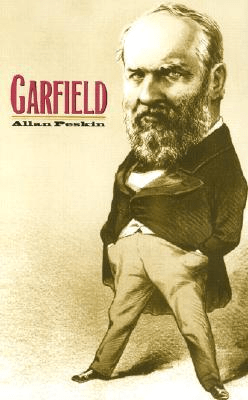
James Abram Garfield (named after a brother who died in infancy) was born in a log cabin in Ohio in 1831. His parents felt the death of the first James was punishment from God for not being religious, so they became Disciples (Campbellites). His father died a couple years later after catching a chill while fighting a fire.
His mother sold some land and took in sewing to make money. His 12-year-old brother Thomas worked the fields of their farm. His sisters Mary and Mehitabel (Hittie) did house work. James was too young to be especially close to his older siblings. When neighborhood boys made fun of him for being poor and not having a dad, he was said to have “the skin of a rabbit” because he was so sensitive.
His mother remarried in 1842, lived with her new husband for a year, then left him. She refused his calls to come back. Divorce was scandalous in those days, so she avoided his calls for divorce until 1850.
During his adolescence, James spent much time daydreaming, once falling into a well while he was lost in thought. He loved hunting and reading fiction.
At 16, he asked a sea captain to take him on, but the captain swore and cursed at him for thinking he could just join like that. He joined his cousin’s canal boat instead, getting a job as the driver, the person who prodded the horses who pulled the barge. Lost in his dreams, he fell into the canal 14 times. Since he couldn’t swim, he had to be fished out each time.
His mother convinced him to go to Geauga Academy where he learned Latin, algebra, grammar, and took part in debates with fellow students. He worked as a carpenter and teacher to make money on the side.
His first time teaching at 19, some of his students were older than him and were quite unruly. One student tried to brain him with a stick of firewood. Garfield earned the students’ respect by disarming him and things went smoothly afterward.
Garfield became more religious, got baptized into the Disciples, and stopped swearing for the rest of his life. He believed slavery was condoned by the Bible. He thought politics was unchristian and didn’t celebrate the fourth of July. He felt the Baptist Geauga Academy had a sectarian spirit and he left in disgust. He also was ashamed of his poverty. He couldn’t afford meat, wore homemade clothes with patches and a straw hat. He felt better-dressed students judged him.
The Disciples founded a school called Western Reserve Eclectic Institute which Garfield attended with four of his cousins. He worked as a janitor at the school and was still poor, but other students didn’t look down on him here. He was six feet tall and could outrun and out wrestle his classmates, which earned their respect. He also studied hard and excelled at debate. (He once “won” a debate with an atheist by asking him what the present participle of “to be” was in Greek and the atheist didn’t know.)
He was fond of lofty language and filled his diary with romantic musings on nature in a Byronic style. When he first visited New York, he avoided the usual tourist attractions and instead spent his time meditating in Greenwood Cemetery, reciting Gray’s Elegy to the tombstones.
He courted a girl named Mary Hubbell who thought they were engaged. It caused a minor scandal when he broke up with her. He began preaching at 20 which earned him a dollar a sermon. He focused on God’s love rather than hellfire. He switched from being a student to a teacher at the Eclectic, having learned all they could teach him.
He drew close to one of his Greek students, Lucretia “Crete” Rudolph. She behaved coldly towards him while he was emotional. Although they were engaged, he thought she didn’t love him as much as he loved her and thought about breaking things off until she showed him her diary which revealed the depths of her feelings.
He thought about going to Bethany, a Disciple college in Virginia and met founder Alexander Campbell himself, but was prudishly shocked by a college theatrical almost as obscene as Shakespeare and decided to continue his studies at the Calvinist Williams College in Massachusetts instead where he saw mountains for the first time.
He heard Ralph Waldo Emerson speak and was very impressed. He asked a phrenologist how high a place in the world he should aim for and was told as high as he pleased.
His fellow students looked down at him at first for being a Campbellite, but he earned their respect with his debate skills. He was known for making people laugh. He once compared a debate opponent who flailed his arms around to Don Quixote attacking a windmill, or rather the windmill attacking the knight. He wrote a satirical poem titled “Sam” mocking the Know Nothing Party. He also grew close to Rebecca Selleck who, unlike Crete, was as sentimental as he was.
After graduating from Williams, he went back to being a teacher at the Eclectic and soon became president of the college. He made it more secular than before (although it was still a religious school) in order to attract students other than Disciples. He put less emphasis on Greek and Latin and more focus on practical education. He also continued being a teacher and focused on cultivating independent thought over rote memorization. He treated his students with kindness and would join them in sports.
Enrollment rose and the school did well financially, but Garfield wanted to do more with his life. He still hadn’t married his fiancée over four years after becoming engaged. He still wrote letters to Rebecca and visited her out east, but he couldn’t very well marry anyone other than Lucretia after their long engagement (plus her father was a prominent trustee of the school). He finally married her in November 1858 in a quiet ceremony. For some reason, they were married by a Presbyterian rather than a Disciple and had no honeymoon.
He liked chess and wanted to start a league with other colleges, but those who considered it a vain amusement kept it from happening. Previously indifferent to slavery, he grew to view it as a sin and once sheltered a runaway slave on his way to Canada. Hearing a couple runaway slaves had been caught, he assembled a group of vigilantes to rescue them; only to discover it was a couple of pranksters in blackface.
He gained some local fame during a debate series with an atheist in which they gave over twenty speeches in five days. He got elected state senator in Ohio and became friends with fellow senator Jacob Donelson Cox who he shared a bed with in a boarding house (it wasn’t unusual for men to share beds to save money back then). Garfield was described as a bear of a man who would hug his friends so hard it would almost make their ribs crack. He roared with laughter, and had a vise-like grip.
His marriage wasn’t going well. He told Lucretia that their marriage had been a great mistake. On July 3rd, 1860, they had a daughter named Eliza, nicknamed Trot. Garfield left town the day after her birth to give a Fourth of July speech. He gave many speeches during the campaign season, including over forty for Lincoln. Garfield had been reading law in his spare time and in early 1861 passed the bar. Although he was now a lawyer, he had no intention of practicing.
When the Civil War started, Garfield was eager to join the fight. A phrenologist had told him he had the bumps of a general, after all. The governor made him colonel of the 42nd Ohio Volunteer Infantry. Garfield had to recruit his own troops, many of them students who were eager to serve under their principal. Having no previous military experience, he learned on the job.
His regiment was ordered to eastern Kentucky to engage with Confederate troops led by Humphrey Marshall. Garfield was outnumbered at Paintsville, but tricked the Confederates into thinking his army was larger by dividing it into three groups which marched on three different roads with the cavalry in front to mask their actual size, causing Marshall to retreat. He won a bloodless victory without firing a shot.
He chased Marshall’s troops and engaged the enemy at the battle of Middle Creek. Garfield estimated that 125 Confederates were killed, while Marshall estimated 250 Union troops had died. It was a hard-fought, strenuous battle, but in reality, only 3 died on the Union side and only 11 on the Confederate side. Although Marshall retreated again, he claimed victory because Garfield needed to resupply and didn’t continue chasing after him!
Garfield became a hero and received a promotion to brigadier general. He had not sought the promotion. He had a superstition against “place-seeking”, preferring to leave his career up to fate. If an opportunity was given to him, he’d take it, but he wouldn’t seek it out.
Once the Confederates abandoned Kentucky, Garfield began the process of reconstruction. The people of eastern Kentucky lived in extreme poverty and ignorance. They had never been to a church, had never heard of railroads, and were amazed by a simple jackknife. They had only supported the South because the Confederates told them the Yankees were going to murder them, and they didn’t even know what a Yankee was. Many hadn’t even heard of Lincoln’s election. Instead of punishing them, Garfield gave them amnesty. Many of Marshall’s troops deserted and returned to their families. However, Garfield was strict when he needed to be. He ordered one of his own soldiers hanged for shooting a Rebel prisoner.
He got an opportunity to become a sailor at last. With supplies running low, he took a steamer up the Big Sandy River which had risen so high, all the captains refused to navigate it. An epidemic killed 50 of his troops, many of them boys he had recruited from his school. “This fighting with disease is infinitely more horrible than battle.”
Before leaving eastern Kentucky, Garfield attacked Pound Gap on the Kentucky and Virginia border which was supplying bushwhackers in eastern Kentucky. Garfield’s favorite strategy in battle was the flank movement (dividing his troops into two groups, one attacking from the front, the other sneaking up on the enemy’s rear). He would use this same strategy over and over again, even though it usually didn’t work. (In order to work, it required precise timing.) At Pound Gap, his frontal assault reached the enemy first, causing them to retreat before his rear troops could get into place. Garfield fired his only shot of the war. His men said he killed someone, but he hoped they were wrong.
Garfield was next assigned to command 4,000 men who hadn’t seen battle yet. They marched to join Grant at the Battle of Shiloh, but the rebels retreated just as they got there. Garfield recklessly dashed ahead of his men, exposing himself to fire. One stray shell barely missed him, and turned an officer next to him into “a quivery mass of bleeding flesh.”
They pursued the enemy to Corinth, sleeping for weeks in wet uniforms and sleeping on a campsite that was actually the burial ground for thousands of decaying corpses. Disease was once again rampant. The Confederates retreated again and the Union army didn’t know where they had went.
Many Northerners thought the war was being fought to preserve the Union, not free the slaves, but Garfield disagreed. When Garfield was ordered to surrender a fugitive slave hiding in his camp, he vehemently refused his commander. During a court martial trial, Garfield got sick. He had diarrhea, jaundiced skin, lost 43 pounds, and had to be carried to court the last ten days. When the trial was over (the accused man was drummed out of the service despite Garfield’s objections), he was finally given sick leave.
His wife nursed him back to health. It was the first time since they got married four years ago that the two spent a significant amount of time together. Their fractured relationship began to mend. Meanwhile, his friends got him elected to the US Congress. (Garfield as usual didn’t campaign for himself.) However, he still had a year of military service before he would become a congressman.
While awaiting his next assignment, Garfield befriended and moved in with Secretary of Treasury Salmon Chase, who turned out to be a fellow chess enthusiast (they would often play six games a night, keeping visitors waiting until the current match was done). He would escort Chase’s daughter Kate, the reigning beauty in Washington, around town. He also became fascinated by economics. He was eager to join the fight again and had one of his characteristic bouts of depression while waiting for his next assignment.
While continuing to wait, he paid a visit to his college sweetheart Rebecca Selleck and also had an affair with a Mrs. Calhoun. His wife found out and wrote him a letter. He apologized and they seemed to reconcile once again.
Garfield was placed on a court of inquiry looking into the actions of his friend General Irvin McDowell, who Garfield would later name one of his sons after. He hid his bias in favor of his friend, but ended up being reassigned to another case for administrative reasons. He nearly finished writing a manuscript about Frederick the Great, when he finally got an assignment to rejoin the war effort in Tennessee as chief of staff to General William S. Rosecrans.
Rosecrans was full of nervous energy and would often wake Garfield up at midnight to have long conversations with him on a variety of topics until 3 or 4 in the morning. Trying to get some sleep, Garfield once rented quarters on the other side of town, but one of Rosecrans’ aides found him even there. Brought up to view Catholicism with horror, Garfield was fascinated with Rosecrans, the first respectable Catholic he’d ever met, and he even ended up attending mass with him, though he didn’t convert. He was the only officer close enough to him to call him Rosy.
Generals educated at West Point, like Rosecrans, tended to be overly cautious and delayed attacking. They were trained in European military strategy which taught that the key to winning a war wasn’t necessarily with battles, but in outmaneuvering the enemy and capturing their capital city. Volunteer generals like Garfield correctly saw the path to victory in this instance was in defeating the enemy army, not in occupying cities they had abandoned. He, like Lincoln, just wanted the army to attack already instead of the endless delay of Rosecrans and other West Point graduates.
Garfield’s friend James R. Gilmore, a reporter who wrote boys adventure novels under the name Edmund Kirke, got material for some of his novels from long conversations with Garfield.
When Garfield finally convinced Rosecrans to move, Confederate leader Bragg retreated to Chattanooga and the Union captured Tullahoma. Instead of continuing to pursue the enemy like Garfield wanted, Rosecrans again delayed for a while before marching on Chattanooga. He tricked Bragg into thinking his main force was north of Chattanooga by sending a small detachment to shell the town. By night, they lit a long line of campfires to make it seem like there were more of them, and by day they would pound on barrels to make the rebels think they were building boats to attack across the Tennessee River. They also threw scraps of wood into the river so when the confederates saw them float by, they would think they were building bridges. Rosecrans’ main force approached from the south and Bragg once again retreated once he realized what was happening.
Bragg received reinforcements and attacked the union army at Chickamauga Creek. A miscommunication led to a gap in the Union line on the right wing. Rosecrans thought they’d lost and retreated to Chattanooga. Garfield, however, thought the left wing still held and rode out there. Outnumbered and nearly surrounded, General Thomas held off continuous rebel charges for five hours with Garfield at his side and prevented the confederates from retaking Chattanooga. Towards the end, ammunition was so low, they had to fight the rebels off with their bayonets.
The Confederates laid siege to Chattanooga while reinforcements arrived for the Union side, but the war was over for Garfield who had been called to Washington. On the way there, he briefly met his new son Harry. He began making abolition speeches in Maryland. At one event, a heckler threw a rotten egg at him. Garfield replied that rebels had used more dangerous weapons against him and he was willing to renew the fight right then and there. The crowd turned on the heckler, giving him a good thrashing.
He was suddenly called back home after his first-born child Eliza suddenly died, only three and half years old. He carried his sorrow with him the rest of his life.
Although he would threaten to quit every two years like clockwork, Garfield was a member of Congress for the next 17 years. He was scholarly-minded and spent more time in the Library of Congress than any other congressman. He believed the miseries of the Civil War were divine punishment for slavery. He advocated for equal rights for black men, confiscation of plantations, and death or exile to the leaders of the Confederacy. He also wanted to regulate railroads and was opposed to monopolies. He held Lincoln in disdain for being too moderate and for treating his friend Salmon Chase badly.
After they were married nearly five years, Lucretia pointed out that she and James had only lived together for twenty weeks of that time. Garfield got the hint and rented rooms for his family to live with him in Washington. However, this caused money to be tight.
He entered into a get-rich-quick scheme with his old assistant quartermaster Ralph Plumb. They would buy land cheaply, form a company, then the company would buy the land at an inflated price. They’d be buying land from themselves with money from other people who hoped the land would be rich in oil. However, they failed to find enough buyers for their scam. Garfield next turned to the stock market which was a bit more successful.
Garfield became less radical in his views once the war was over. He was friends with President Johnson and tried to be a peacemaker between Johnson and Congress at first, but when Johnson tried to get rid of the Freedmen’s Bureau, Garfield turned against him.
When Pennsylvania oilmen lobbied him to repeal a tax on petroleum, he turned down their bribe, but did what they asked anyway because he had oil stock and stood to benefit.
He got his first case as a lawyer before the Supreme Court in the most celebrated case of the decade, Ex parte Milligan, less than a week before it was scheduled to be heard. Milligan and his friends had been sentenced to death for helping the Confederates during the war. His friend Chase was now the Chief Justice. Garfield argued that since Milligan was a civilian, he should have been tried in a civilian court rather than a military tribunal, and won the case.
Milligan and his friends never paid him for his services, and the fact he defended rebels hurt him come election time. The Milligan decision could cripple Reconstruction in the South. However, successfully arguing a case before the Supreme Court made becoming a lawyer a real possibility.
He was in favor of impeaching Johnson, but was called away from the vote by his second legal case regarding Alexander Campbell’s will. Campbell’s children challenged the will on the basis of Campbell being mentally incompetent. Garfield won the case and this time got paid $3,000. (He made $5,000 a year in Congress, so being a lawyer was obviously more profitable.) His friendship with Chase ended when Chase supported Johnson during the impeachment trial.
Garfield abandoned his previous speaking style full of Latin tag lines, classical allusions and flowery eloquence. He declared rhetoric dead, replaced by plain speaking. In the age of newspapers, arguments based on history and fact with homely illustrations were better.
As congressmen, Garfield established the Department of Education. However the first commissioner was incompetent and it was soon reduced to a Bureau.
Garfield considered Native Americans to be savages and once suggested they be starved to death by exterminating the buffalo. He later admitted he was wrong.
Garfield built a house in Washington that he couldn’t afford. His old army friend David Swaim loaned him the money and Garfield returned the favor by getting him appointed Judge Advocate General.
When Grant became president, he made an enemy of Garfield by ignoring his recommendation for a local postmaster, a grudge Garfield would carry to his grave.
Garfield was named as one of the bribed congressmen in the Crédit Mobilier scandal. Garfield did take money from them, but he claimed it was a loan, not a bribe, and he did give the money back before the scandal broke. Another scandal broke when Congress voted itself a retroactive pay raise. Garfield was in danger of losing reelection. He was the first congressman to refuse the money from the pay raise and return it to the treasury. And he could have used that money. He couldn’t afford to buy a horse and instead had to rent one by the month. He addressed the Crédit Mobilier scandal in a pamphlet, and the voters in his district once again supported him.
To get reelected, he bribed the editor of the Western Reserve Chronicle with a paid trip to California to write nice things about him in the newspaper. One of Garfield’s agents threatened to shut down the Andover Post Office unless the postmaster got everyone to vote for Garfield. He employed former Disciple Dr. Lewis Pinkerton to spy on his opposition and answer newspaper attacks.
Then another scandal hit. A paving company called DeGolyer had paid bribes to win the contract to pave Washington D.C.’s dirt roads. As congressman, Garfield was influential in paying for this and he had received $5,000 from the company in a clear conflict of interest. Garfield claimed this money had been paid to him in his capacity as a lawyer, however Garfield seems to have done very little legal work for the company.
He once again won reelection, but only because an independent party split the anti-Garfield vote. He was getting tired of public life. He joked that birthdays once seemed like milestones, but now they looked more like tombstones. At home, reading Shakespeare aloud with his wife, she went into labor right after they read this passage from King John: “But on my liege; for very little pains/Will bring this labor to a happy end.” It was another boy. Garfield had been hoping for a girl and consoled himself with a pun: “We receive not, when we ask amiss.” His daughter Mollie burst into tears upon learning the baby was yet another boy. It took them a month and half to name him “the sixth is a little harder to name than the first or second.”
Then another scandal occurred. Back in 1872, Garfield learned that Secretary of War William W. Belknap was taking bribes from a post trader in exchange for the trader getting a monopoly at Fort Sill and charging exorbitant sums. Garfield investigated and cleared Belknap who continued to take bribes until 1876 when he was finally exposed. Belknap resigned and Garfield claimed to be just as surprised as everybody else.
Garfield won reelection again, but his youngest son Neddie died from whooping cough. The day after the funeral, he gave a stump speech to help get Hayes elected president. It was hard to campaign through his grief, but if a Southerner became president, Garfield felt the results would be disastrous.
At first, it appeared Tilden won the election, but Republicans challenged the results in three states. Garfield went down to Louisiana to ensure the vote was counted fairly. Tilden had won Louisiana by over 7,000 votes, however whites had prevented blacks from voting by marching around the streets with guns, whipping them, and even murdering them. Garfield interviewed witnesses and helped the effort to throw out enough votes to make Hayes the winner.
Some Democrats adopted the slogan “Tilden or blood,” threatening another civil war. A bullet was fired through Hayes’ window. Garfield wasn’t worried, though. Democratic congressmen began reaching out to him willing to compromise. Nine Southern Congressmen pledged to make Garfield speaker of the house if David M. Key of Tennessee was appointed Postmaster General (a promise they ended up breaking even though they got what they wanted).
An electoral commission was created to decide who would be the next president. Garfield spoke against it until he found himself appointed one of the commissioners. When the commission decided in favor of Hayes, Democrats began a filibuster to prevent Hayes from being made president. Garfield was part of the meeting in the smoke-filled room in Wormley’s Hotel in which Democrats agreed to let Hayes become president in exchange for removing the Republican-controlled government from Louisiana.
After getting Hayes elected, however, Garfield grew to resent him. Like Hayes, he was in favor of doing away with the spoils system whereby politicians rewarded friends and family with political appointments, however Hayes wouldn’t appoint Garfield’s friends and did appoint his own.
When Southerners wanted to forbid the military from ensuring fair elections, Garfield worked with President Hayes to sustain his vetoes. He even named his dog Veto.
After years in the House, Garfield was finally elected senator. When a friend offered to shake his hand in congratulations, Garfield instead grabbed his friend in a bear hug, lifted him off the ground, and swung him around in circles.
He partly got elected with the help of John Sherman, and Sherman felt Garfield should return the favor and help him get elected president. Garfield wanted to be president himself in 1880. During the Republican convention, Garfield made a lukewarm endorsement of Sherman and insisted he wasn’t running for president himself. Because of his superstition against office-seeking, he left it to his friends to drum up support for him. He won the Republican nomination for president despite his protests that he was really there to support Sherman. Sherman considered it treachery.
For vice president, the Republicans picked Chester A. Arthur, who had lost his job as Collector of the Port of New York due to President Hayes’ Civil Service Reform. (Blanche K. Bruce was the first black man to be considered for vice president for a major party, but didn’t get it. After Garfield was president, he made Bruce register to the Treasury.)
In his letter of acceptance, Garfield attacked Chinese immigration, although he didn’t call for deportation. Regarding the other big issue of the day, civil service reform, he made vague and contradictory statements to try to appease both those in favor and against it.
Since the Southern states Hayes had won were now solidly Democrat, Garfield needed to win New York to become president. Roscoe Conkling controlled the New York Republicans, but he hated Garfield. Garfield negotiated with Conkling’s supporters. After the Fifth Avenue Conference, they believed he had agreed to remove members of the cabinet they didn’t like, and to abandon Hayes’ patronage reforms. Garfield, however, didn’t think he’d made any promises whatsoever. Conkling reluctantly campaigned, but he only said Garfield would make a “competent” president and he sometimes didn’t mention Garfield in his speeches at all!
Democrats brought up Garfield’s past bribery scandals. They adopted the number 329 (the amount of money Crédit Mobilier had paid Garfield) as a rebuke, scrawling it on buildings, barns, fences, sidewalks, and gutters.
Garfield’s campaign emphasized his rags-to-riches story. Horatio Alger himself wrote a campaign biography titled “From Canal Boy to President” in support of Garfield. Garfield also “waved the bloody shirt” by reminding people of the treachery of the South during the Civil War.
However, elections are expensive. Garfield wanted donations from wealthy railroad men and they in turn wanted to pick the new Supreme Court judges (the Supreme Court had recently ruled that the Union Pacific had to pay its debt to the government, which they didn’t like.) Garfield didn’t like this arrangement, but he needed the money, so he agreed to let them veto his Supreme Court choices if they didn’t like them.
Garfield ended up winning. As expected, the former slave-holding states voted for the Democratic candidate due to suppressing the black vote, but Garfield was able to win without the south by uniting the various factions of the Republican party together. Instead of being joyful, the win made Garfield depressed for he realized his life as a private individual was about to come to an end.
As his inauguration approached, the stress of picking a cabinet and writing an inauguration speech caused Garfield to have crippling headaches and nightmares. He dreamed he was riding a canal boat to attend a great ceremony. The boat started to sink. He leapt ashore and watched the boat sink with Chester Arthur still aboard, lying on a couch pale and sickly. Garfield wandered in the storm, naked and alone through hostile country until an old Negro woman nursed and comforted him as if he were a child.
Cabinet members were chosen on the basis of party unity rather than expertise. (For example, Hayes’s Secretary of the Navy Richard Thompson had never been aboard any vessel larger than a rowboat. When he toured a warship for the first time, he was astounded: “Why, the durned thing’s hollow!”)
He picked Robert Todd Lincoln, the past president’s son, as Secretary of War despite the fact he had little experience, because of his famous name. He picked a New Yorker for the Navy department, but Conkling considered anything less than State or Treasury an insult and forced his man to not accept. Garfield’s Secretary of State James Blaine badgered Garfield into picking men he wanted in the cabinet. Blaine selected a New Yorker for Postmaster General, infuriating Conkling.
In his inauguration speech, Garfield promised to uphold the rights of black people. He praised education, farmers, and industry. He promised to be strict with government spending and to faithfully execute the laws. The only discordant note in his speech was a sudden passionate denunciation of the Mormons.
He moved into the White House with his mother, wife and children. His youngest son Irvin would bring his high-wheeled bicycle indoors when the weather was bad outside and would ride it through the corridors and down the stairs, gouging chunks from the historic wainscoting and sending the lines of office seekers scattering.
The Hayes White House had banished alcohol and Hayes advised Garfield to do the same. While Garfield preferred milk to wine, he didn’t mind a drink now and then and allowed wine back into the White House. Garfield didn’t own a horse or carriage, so Hayes offered to loan him his carriage and sell him some horses. (However, Doc was lame and Ben was blemished.)
Over a hundred thousand civilians were employed by the federal government and it was expected each new administration would replace a significant portion of them. In the early days of his presidency, thousands of office-seekers waited patiently in line outside the White House to speak to the president. They laid siege to his office and accosted him on the street. Garfield gave jobs to his friends, family, and those who helped him get elected. He even gave a diplomatic post in Constantinople to Lew Wallace after reading his novel Ben Hur, to help him get material for a sequel.
But he didn’t have enough friends and relations to fill 100,000 jobs. He was thus in favor of civil service reform, not because he was opposed to the corruption of the current system, but because job-seekers took up so much of his time. Blaine was only too happy to offer suggestions for several appointments and many considered him to have too much influence over the president. At Blaine’s suggestion, Garfield appointed an enemy of the Attorney General to be his second in command.
Trying to build bridges, Garfield appointed some men friendly to Conkling, but this caused Blaine to threaten to resign. To make things up with him, Garfield approved a reshuffling of positions devised by Blaine, which gave Blaine’s friend Collector of the Port of New York, an extremely influential position with fifteen hundred workers under his command. This offended both Conkling and former president Grant, as well as the reform Republicans who joined with their enemy Conkling in denouncing Garfield’s decision. It also caused his Postmaster to threaten to resign.
Just three weeks into his presidency, Garfield had managed to make enemies of nearly everyone who helped get him elected. He hastily backed down and asked for a meeting with Conkling to smooth things over, but Conkling refused to meet him, so Garfield then declared war on Senator Conkling. Although he admitted the appointment of Blaine’s friend to the Port of New York had been a mistake, he now defended the decision due to the principle of the thing. The president should be able to make appointments without the senate’s approval.
Garfield’s bold move proved popular with voters and Republicans realized they had to support the president. Conkling resigned from the senate. Garfield had won.
At Garfield’s urging, Secretary of State Blaine wanted to create a Pan-American Conference to promote peace and increase trade in Latin America. Garfield successfully refunded the national debt by giving owners of six percent bonds the option of holding them at three and a half percent. Garfield was alerted that his former campaign manager Stephen Dorsey was committing fraud by overcharging for postal star routes. Garfield ordered an investigation and the Attorney General began preparing his case.
Charles Julius Guiteau believed God had selected him to remove the president. Mental illness ran in his family. He was a member of the Oneida community which believed the Second Coming had already happened, we were already living in the promised Millennium, death was optional, and practiced complex marriage or free love. He believed he would become president of the United States and then the world. The Oneida community rejected him. He tried and failed to start a religious newspaper. He tried to blackmail the Oneida community. He became a lawyer, but during his only case, he ranted and raved about God for an hour while shaking his fist at the jury, which immediately convicted his client. He became a debt collector, but often kept the money for himself.
He married a librarian. If she contradicted him, he’d lock her in a closet. They never had a home, but instead moved from boarding house to boarding house in the dead of night to avoid paying rent. He tried and failed to get a political job and vowed that if he couldn’t get famous for good, he’d get famous for evil by shooting a politician.
His wife left him after he got syphilis from a sex worker. His debt collection business ended when a newspaper printed an article exposing his fraud. He was thrown in jail. His brother-in-law bailed him out, but then Guiteau went after his sister with an axe. They tried to have him committed, but he escaped across the state line. He wrote a book called The Truth which plagiarized the Oneida community’s The Berean. He crisscrossed the country giving rambling lectures, skipping town whenever rent was due. He once jumped from a moving train to avoid an irate conductor.
In 1880, he wrote a speech to help elect Grant. When Garfield got the nomination, he added a bit about Garfield to the end of the speech. He never actually delivered this speech, but was convinced it’s what got Garfield elected. He would hand out copies of his speech at party functions, not realizing he was an object of ridicule. Instead, he thought he was on the path to becoming president himself. He mailed a copy of his speech to Garfield and expected to be rewarded by being made Minister to Austria. He expected to marry the daughter of a recently deceased Republican millionaire. He listed Ulysses S. Grant and other prominent men he didn’t know as references.
He was one of several office-seekers who approached Garfield looking for a job who didn’t get one. He pestered Blaine and other Republican leaders without success. He kept showing up at the State Department despite repeated dismissals and the White House despite always being told month after month that the president couldn’t see him today. He finally realized that he had to remove the president.
He purchased a revolver and tracked the president for a month. Garfield did not have a bodyguard. Guiteau thought about shooting him at church, but the angle of fire was too difficult. When the newspapers announced he would be leaving with his wife to New Jersey, he planned to shoot him at the train station, but chickened out upon seeing how frail his wife was. (She had fallen ill and was leaving Washington for her health.) He was ready with his revolver when Garfield returned from New Jersey, but the day was hot and muggy and he didn’t feel like shooting him then. He continued to follow Garfield and continued to come up with excuses not to do it.
Finally, when Garfield was about to leave Washington for summer vacation, he couldn’t delay any longer. He waited at the Baltimore & Potomac train station for Garfield to arrive.
About to leave on vacation, Garfield was in a good mood for once. Before leaving the White House, he tossed his sons about to the tune of “I mixed these babies up” from his favorite Gilbert and Sullivan musical.
When he got to the station, Guiteau shot him twice, then put the pistol back in his pocket. He was apprehended by police and put up no resistance. He said he was a supporter of Arthur who was president now.
One bullet had just grazed his arm. Doctors poked and prodded Garfield’s wound with their unwashed fingers and instruments in search of the other bullet, but couldn’t find it. They thought he’d probably die within a day. His sons Harry and Jim cried uncontrollably while a dozen doctors milled around suggesting remedies. Blaine, who’d accompanied Garfield to the train station also wept. Robert Todd Lincoln was also present and devastated by the assassination. After some brandy, Garfield revived enough to ask to be taken home to the White House.
A special train was arranged to bring Lucretia and Molly to the White House. Garfield’s mother had been attending a funeral for a cousin and uncle who had died in a train accident. It was feared the news would be too much for her, so she wasn’t told about her son until the next day. Garfield’s sons Irvin and Abe were on a train to their home in Mentor when it happened. The conductors and station masters along the route kept the news from them so they didn’t find out until they were back home.
Vice President Chester A. Arthur had never masked his contempt for Garfield or his close ties to Conkling. The thought of him replacing Garfield as president horrified many.
The doctors were surprised to find Garfield had lived through the night and also appeared more cheerful and rested. Garfield would never again arise from his sickbed, but it would be eighty days before he would die. As summer continued, the temperature rose to the upper nineties. Suggestions on how to cool the room poured in from across the country. Scientist Simon Newcomb and the Navy engineers invented one of the first air conditioners to help the fallen president.
The doctors kept poking at the president’s wound with dirty fingers and instruments to try to find the bullet. Alexander Graham Bell even invented a metal detector to help look for it, but he failed it find it as well.
Guiteau blamed Garfield’s death on the doctors. “The doctors did that. I simply shot at him.” Guiteau was hanged to death, still believing he had done God’s work to the end. Many in the public agreed Garfield’s true cause of death was medical malpractice, although other sources of infection such as the putrefying fragments of shattered vertebrae could have been what ultimately killed him.
The country virtually closed down every summer, so a president wasn’t needed while Garfield lay in his sickbed. By this time, the country had come around to the idea of Chester A. Arthur as president. Garfield continued to undergo surgeries, nutrient enemas, and vomiting sessions. He had once weighed over 200 pounds and was now down to 135.
By September, Garfield was sick of being cooped up. The doctors allowed him to be transferred to Elberton, New Jersey, near the president’s favorite seaside resort of Long Beach. On September 6th, streets were cleared of traffic as he was taken to the train station. He was taken to a specially modified train that burned only anthracite coal to reduce smoke and fumes. Boxes of ice and a false ceiling were installed to cool the train car. Approaching trains had to stop so the noise wouldn’t disturb the president. Houses along the route were set up as emergency medical shelters in case the trip had to be cut short.
People along the train route bowed their heads and removed their hats as the train passed. It was declared a national day of prayer. The train pulled up to Franklyn Cottage. Two thousand volunteers had built a spur to connect the railroad to the front door of the cottage. The president’s car was uncoupled and pushed to the cottage by hundreds of hands along this spur. The president himself was carried upstairs to a bedroom facing the ocean. He recovered a bit, then fell into illness again. He died a few weeks short of his 50th birthday.
His daughter married his private secretary who she’d had a crush on for years. One of his sons became an architect, the other three became lawyers. Jim went on to be a politician and became Theodore Roosevelt’s Secretary of the Interior and Harry became President of Williams College.
Garfield was president for less than seven months, and he was confined to a sick bed for nearly three of those months, so he didn’t have time to do much as president. As far as I’m aware, he didn’t cause any deaths while he was president or save any lives.
Garfield was in favor of civil rights and appointed many African Americans to prominent positions. He saved taxpayers an estimated $10 million dollars with his refinance of the national debt. He attempted to negotiate peace in the War of the Pacific being fought by Bolivia, Chile, and Peru, but didn’t have time to see these negotiations bear fruit. He called for a Pan-American Conference to promote peace and increase trade in Latin America, but once Arthur was president, he cancelled the conference. We’ll never know what Garfield could have accomplished if he had served a full term.
 Mania Delight