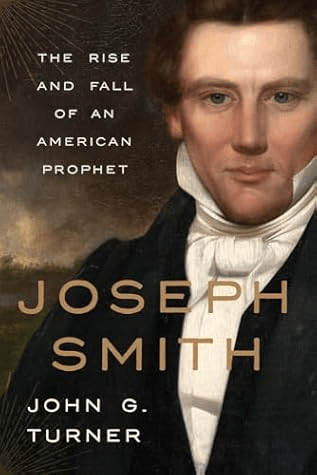
I like that Turner puts Smith into context, telling us what his contemporaries thought of him and what else was going on at the time. You can’t really understand Joseph Smith without understanding early 1800s America. Turner isn’t a Mormon himself, but he’s writing with a Mormon audience in mind. He obviously admires and sympathizes with Joseph Smith Jr., but he also criticizes some of the things he does.
Joseph had a hard life full of setbacks. Several of his children died in infancy. He was attacked by mobs. Most of his closest friends and family turned against him at some point. You feel bad for him, but he was also a scoundrel (in the intro, Turner says he wouldn’t trust Joseph with his money, wife, or daughter.) Joseph was quick to anger, but he was also quick to forgive.
Joseph Smith Jr. was born in 1805 in Vermont. He was one of eight children. His family was poor and would move often, hoping to improve their financial prospects. Supposedly, Joseph was born with a veil (the amniotic membrane) over his head, giving him supernatural healing or treasure-finding gifts. At 7, his tibia was infected and parts of the bone had to be removed. He walked with crutches for several years afterwards and had a slight limp into adulthood.
As a child, Joseph used a dowsing rod to search for treasure like his father, but later he switched to being a glass-looker, i.e., someone who used a seer stone. Family and friends continued to believe he could find buried treasure even though he failed at every attempt.
His oldest brother Alvin died in 1823. It was a big blow to the family since they were relying on him financially. Joseph Sr. was past his prime by this point and had become a drunk. 10 months later, the Smith family dug up Alvin’s corpse to make sure it hadn’t been taken by body snatchers.
In 1825 shortly before turning 20, Joseph met his future wife Emma while out of town for a treasure dig. Her father opposed the marriage, so Joseph married her while her father was away. He promised to give up glass-looking and her father allowed them to live on his property.
After obtaining the gold plates, other seers such as Luman Walters and Sally Chase apparently used their rods and seer stones to find where Joseph hid the plates, so he had to move them. Joseph didn’t allow anyone to see the plates, but Emma was allowed to feel them and said they were pliable like thick paper.
According to Royal Arch Masonry, Enoch hid a golden plate underground which was discovered by the architects of Solomon’s temple. Joseph liked to fool people, wanted to prove himself as a treasure finder, and was in desperate need of money. So Turner thinks the most likely explanation is the gold plates didn’t exist.
Martin Harris and his wife both provided funding for Joseph’s Book of Mormon. Despite being 20 years older than Smith, the two liked to wrestle. Harris beat his wife, which wasn’t uncommon for the time.
When Emma’s father threatened to kick Joseph out if he didn’t pay for the house he was living in, Oliver Cowdery made the down payment for him.
Cowdery served as Joseph’s scribe and wanted to translate ancient records himself. Jesus told Joseph there were many other ancient American records besides the Book of Mormon that Cowdery could translate, but it didn’t work out.
Publishing the Book of Mormon cost $3,000. Joseph had a vision from Jesus that Martin Harris should pay it. Harris mortgaged his farm, which he ended up losing. Harris thought money made from selling the Book of Mormon would go to paying him back. Joseph wanted to keep all the money himself, but begrudgingly let Harris make some money from selling copies of the Book of Mormon himself. Joseph secretly sent some followers to sell the Canadian copyright without telling Harris so he could keep all the money himself, but that ended up not working out.
While writing the Book of Mormon and founding a new religion, Joseph neglected his crops and neighbors thought him lazy. He was away from his wife Emma much of the time. She was worried he wouldn’t be able to put food on the table. Joseph received a revelation telling her to not complain and to fully support him.
Hiram Page, one of the eight witnesses who saw the golden plates with his spiritual eyes, found a seer stone and started receiving revelations the same way Joseph did. Cowdery also claimed to speak in the name of God. Joseph had a revelation that only he could receive revelations and that settled that.
Like other Christian leaders at the time, Joseph said Christ would return soon, but unlike others, he claimed Native Americans joining his church would bring it about. He sent out missionaries to Native Americans at the same time President Andrew Jackson initiated his Indian Removal Program and the Trail of Tears.
In 1831, Joseph moved to Kirkland, Ohio in order to flee creditors. Members would speak in tongues, or as they called in, “talking Injun”. They also enjoyed “playing Indian” pretending to scalp people or sliding on the floor to mimic rowing a boat.
When he arrived in Ohio, he found rival revelators, a boy named Heman Bassett, a former slave named Black Pete, and a woman named Laura or Louisa Hubble. He received another revelation telling everybody only he spoke for Jesus and Jesus wanted them to build a house for Joseph. He also ordered the members to give him all their property. Members would be given back what they needed with the church keeping what was left over.
In April, Emma gave birth to twins who died after a few hours. At the same time, a woman named Julia Murdock died giving birth to twins. Joseph told the father he and Emma would raise the twins.
Joseph had a permanent bald spot from when someone yanked out his hair during a tar and feathering. The mob also knocked out one of his teeth and he spoke with a whistling sound until he got a replacement tooth. Baby Joseph, the adopted twin, died shortly after the mob attack.
Emma got pregnant a third time and this time the child, a boy also named Joseph, lived. During Emma’s pregnancy, Joseph went to New York City, but was apparently intimidated by its size. Rather than preaching, he stayed in his hotel room most of the time.
When Mormons were kicked out of Missouri, Joseph put together an army to reclaim their land. However, the Mormons were outnumbered and he received a revelation telling him to back down for the time being until they could recruit more fighters. No fighting ended up happening, but 15 people died of cholera.
Joseph got his ideas from the world around him. Josephus and the Scottish philosopher Thomas Dick were popular at the time, for example.
In 1835, a dispute arose between Joseph and his brother William over a 15-year-old girl named Lucena Elliott. She had been beaten and whipped by her father and had become suicidal. Joseph was on her father’s side while William thought her father had gone too far.
The brothers were still angry with each other a couple months later when Joseph turned 30. Joseph didn’t invite William to his Christmas party and suggested the debate club held at William’s house be discontinued. He also said William was “ugly as the devil”. They got into a physical fight which Joseph lost. Other men had to rescue him. He was beaten so badly, he couldn’t stand up or sit down without assistance.
William apologized, but Joseph didn’t accept his apology right away. The two reconciled a little while later.
To prepare for dedicating the Kirkland Temple, Joseph, Oliver Cowdery, Martin Harris, and John Corrill washed each other’s bodies and bathed in whiskey perfumed with cinnamon. This is in keeping with the Word of Wisdom which advises Latter-day Saints to wash their bodies with strong drinks, a fad at the time.
In 1836, Joseph was opposed to freeing slaves, but also ordained an African American named Elijah Able to the church.
After Emma had given birth to a boy named Frederick, she caught Joseph having sex with their maid Fanny Alger. Emma kicked Fanny out of the house and Joseph suddenly decided he needed to travel for the next seven weeks to give Emma’s anger time to subside. He went to Salem on a treasure quest. He was told a certain house had a lot of money hidden in the cellar, but he failed to find the treasure.
When Joseph’s illegal bank failed, several high-ranking church members, including apostles and Book of Mormon witnesses, left. Emma was left to deal with creditors and three young children while Joseph fled the state to avoid a lawsuit.
Fleeing his numerous creditors, Joseph abandoned Kirtland, Ohio and made Missouri the new home of Mormonism. The Mormons vowed to not get pushed around anymore and formed a secret militia called the Danites.
There were rumors justice of the peace Adam Black was organizing an anti-Mormon mob, so a mob of armed Mormons led by Joseph Smith surrounded his house. They left peacefully, but a warrant was issued for Joseph’s arrest for threatening Black.
In De Witt, Missouri, Mormon and anti-Mormon mobs had skirmishes in which they fired upon each other. Mormons and militia officers asked Governor Lilburn Boggs to do something, but he refused to act. Being outnumbered, Joseph retreated.
He was determined not to back down again. Joseph called for saints to fight back. Mormons raided communities in Daviess County, pillaging stores, stealing cattle, and burning homes as non-Mormons fled in terror. The Mormons now controlled Daviess County, but apostles Thomas Marsh and Orson Hyde were disgusted by the raids and left the church.
Non-Mormons fought back. The Ray County militia took three Mormons prisoner. Mormons attacked the militia and apostle David Patten was wounded in the skirmish. Joseph’s healing prayer failed to work and Patten died.
Vigilantes massacred the Mormons at Hawn’s Mill. Governor Boggs called for Mormons to be exterminated. The state militia approached Far West. Outnumbered, Joseph surrendered.
Mormons left the state while Joseph awaited trial in Liberty Jail. He was found guilty of treason, rioting, and arson, but it wasn’t a fair trial. Some members of the jury had slaughtered Mormons at Hawn’s Mill. The judge gave orders to let Joseph escape.
The Mormons then moved on to Nauvoo, Illinois on the banks of the Mississippi River. It was swampy and many saints contracted malaria.
Joseph taught that the ten lost tribes of Israel were removed along with a chunk of earth that would be returned at the second coming. He taught that Paul fought with beasts at Ephesus that often killed him, but he came back to life repeatedly.
Joseph got the idea of spirit prison and baptism for the dead from Ann Booth, an English convert who had a vision of Dave Patton in the spirit world unlocking a prison and baptizing John Wesley, the founder of Methodism. The Mormons held proxy baptisms for George Washington and newly departed U.S. President William Henry Harrison.
In 1840, huckster John C. Bennett joined the church. Bennett was a Methodist preacher, but also sold diplomas, medical tonics, and bred chickens. He quickly became Joseph’s right-hand man. He had a way with politics, getting Nauvoo incorporated as a city and making it a safe haven.
According to a law he got passed, residents of Nauvoo couldn’t be taken prisoner by officers of the law in other jurisdictions and created a militia called the Nauvoo Legion making it more powerful than any other city in Illinois. Bennett was elected mayor of Nauvoo and made major general of the Nauvoo Legion with Joseph as the first Lieutenant General since George Washington.
Joseph began to secretly practice polygamy in Nauvoo, not telling church leadership, his brother, or his wife. Most of the women he married were already married to members of the church in good standing and remained living with their original husbands afterward.
Joseph didn’t produce children with any of them, so sexual encounters were likely infrequent. Sometimes he married both a woman and her daughter, a couple of girls for whom he was guardian, and some of his wives were as young as 14. He married a variety of women, both old and young. The only pattern is he married women he thought he could trust to keep a secret.
The Book of Mormon was anti-Mason, matching the general feeling at the time it was written. By 1840, anti-Mason sentiment in the country had receded and Joseph became a Mason, creating the largest lodge in Illinois. He promised to give women the priesthood, using Masonry as an entry point.
It came to light that John C. Bennett was having sex with many women in town. Joseph initially got everyone to forgive him, but later turned on him. Bennett left town and Joseph took over as mayor and continued marrying women.
He had a falling out with Sydney Rigdon for trying to marry his daughter and a falling out with Orson Pratt for trying to marry his wife. Joseph attacked their reputations and accused the women of sleeping with Bennett. The men eventually returned to being loyal to Joseph.
Someone had shot Governor Boggs of Missouri and the prime suspect was Joseph’s friend Porter Rockwell. Rockwell was in town at the time and Joseph had prophesied that Boggs would die, making them both look guilty.
A writ was issued for their arrest. Joseph and his friends quickly passed a law that prevented them from being extradited from Nauvoo. Whether a city law could override a state or federal law created enough confusion for Joseph and Porter to escape from the sheriff.
While in hiding from the law, he was visited by Emma and, unknown to Emma, one of his other wives, the much younger Sara Ann Whitney. He gave Sara Ann’s parents blessings in return.
When a new Illinois governor friendly to Mormons was elected, Joseph turned himself in and Missouri’s extradition order was cancelled.
Nauvoo became the biggest city in Illinois except for Chicago. Joseph borrowed money from church members to pay his many debts. He kept marrying more and more women, and allowed other men to practice polygamy making it harder to keep secret from Emma.
He eventually told her. He received a revelation from Jesus telling her she had to accept his extra wives but she couldn’t have any other husband. She destroyed the revelation, but he’d made a copy. She opposed polygamy, but didn’t leave him.
Joseph beat up the county tax collector for seizing church land he said the Mormons hadn’t paid their taxes on. The tax collector and others outraged by Joseph’s unchecked power formed the Anti-Mormon Party. They didn’t like that the Mormon voting bloc controlled Illinois elections and Nauvoo’s habeas corpus power kept Joseph from standing trial.
As word of polygamy spread, many Mormons began to turn against Joseph. Emma made Joseph renounce the practice and he told her he would. However, he continued it in secret.
A couple Mormons were accused of stealing a horse and locked up in Missouri. In retaliation, Joseph kidnapped John Elliot, a man he thought responsible and locked him up. He also ordered the arrest of the militia leader who arrested the Mormons, but he had too many armed friends. Joseph backed down and also released Elliot.
William Law, counselor in the First Presidency, was disgusted with Joseph’s polygamy. Joseph made false accusations that Law was adulterous and that his wife wanted to marry him. Joseph warned him to keep his secret. Nauvoo police told Law that his life was in danger.
In 1844, at the age of 38, Joseph ran for president of the United States. Texas wanting to join the US as a slave state (and trigger a war with Mexico) was the main issue of the election. Joseph wrote that Africans were cursed with dark skin in the Book of Abraham and his revision to the Bible. Nauvoo prohibited black men from voting, serving in the military or holding office. He wanted a strict separation of the races. However, by 1844 he was at least opposed to slavery.
William Law and others opposed to Joseph published a newspaper called the Nauvoo Expositor accusing Joseph of polygamy and having too much political power. Joseph ordered the destruction of the printing press.
When authorities tried to arrest him, he declared martial law and called upon the Mormons to fight to the death if necessary. However, when the governor threatened to send in the state militia, he fled.
Nearly all the Mormons, including his wife Emma and brother Hyrum, thought Joseph should turn himself in, post bail, and return to Nauvoo to save the city from mobs. Joseph received a revelation to do just that.
However, because he’d called out the Nauvoo Legion, he wasn’t just being arrested for the printing press, but being charged for treason and thus couldn’t just post bail. A mob stormed the jail and killed Joseph.
I already knew most of the material in this book, but it does a good job of putting Joseph’s life into context. He certainly was a scoundrel, but he was also unfairly persecuted by mobs. You can’t help feeling both bad for him and mad at him at different times.
 Mania Delight