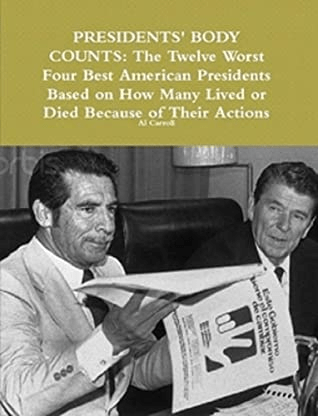
Presidents’ Body Counts by Al Carroll Part 2

Bill Clinton

Clinton not only didn’t try to stop the Rwandan genocide, he pushed for the UN to withdraw and denied a genocide was happening. Clinton could have saved 300,000 to 600,000 lives if he’d sent just 5,000 US troops to intervene.

Right-wing terrorists murdered at least 288 people from 1995 to 2012 and attempted to assassinate Clinton, George W. Bush, and Obama. Clinton’s mishandling of the Branch Davidians, Randy Weaver, and the Republic of Texas militia led to more recruitment for right-wing terrorists.

Continue reading

Presidents’ Body Counts by Al Carroll Part 1

When presidents of the United States are ranked from best to worse, they’re generally judged on subjective things like leadership, charisma, etc. and the lists end up merely being a popularity contest, often based on the politics of the person doing the ranking. George Washington is often listed as one of the best presidents, not because he did anything particularly noteworthy while president, but simply because he was the first.

Continue reading

The 1619 Project by Nikole Hannah-Jones

“White Americans desire to be free of a past they do not want to remember, while Black Americans remain bound to a past they can never forget.”

The 1619 Project is a collection of essays, flash fiction, and poetry from a variety of writers concerning the experience of Black Americans. Black history is not well taught in US schools. Unbelievably, in 2017, only 8 percent of high school seniors named slavery as the central cause of the Civil War!

Continue reading

The Word of the Lord by Harry Edgar Baker

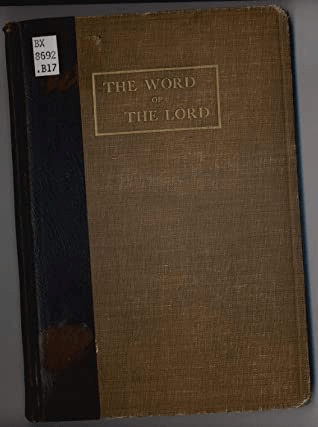
There are three different texts titled The Word of the Lord used by different Mormon splinter groups. One was written by Otto Fetting between 1927-1933. Another was written by William Draves starting in 1933. However, I could find next to nothing online about about the text written by Harry Edgar Baker between 1916 to 1918. Wikipedia mentions the other two books sharing this title, but not this earlier one.

Continue reading

Noise by Daniel Kahneman, Olivier Sibony, and Cass R. Sunstein

55339408.jpg (258×400)

When it comes to errors in human judgment, we tend to focus on bias, but noise is also a cause of error. Bias is the average of errors committed by a group. You need to know the right answer to know what the bias is. Bias is systemic and predictable. Noise, on the other hand, is variable amongst a group of judgements. You can tell there’s noise even if you don’t know the right answer. It’s unpredictable and not easily explained.

Continue reading

Enlightenment Now by Steven Pinker

35696171._SY475_.jpg (315×475)

The world is better today because of the Enlightenment, yet people attack reason, science, humanism, and progress when these things should be celebrated.

One of the bits of wisdom from the Scientific Revolution is that misfortune is no one’s fault. Bad things sometimes happen for no reason other than the universe is indifferent to human suffering. There’s no point looking around for someone to blame when an earthquake happens. Entropy ensures there’s more ways for things to go wrong than for things to go right.

Continue reading

The Principles of Nature by Andrew Jackson Davis

42773155._SY475_.jpg (297×475)

In the introduction, we’re given a description of Andrew Jackson Davis which would appeal to a phrenologist, as well as testimonials from his acquaintances. We’re told he was poor and barely educated, only attending a few months of school, so he only knows the basics of reading, writing, and arithmetic. Although we’re also told he knows all the technical medical terms, so maybe he’s not as ignorant as they want us to believe. He’s only 20 years old.

Continue reading

Berossus and Genesis, Manetho and Exodus by Russell E. Gmirkin

2483351.jpg (246×400)

According to the Documentary Hypothesis, the Pentateuch was composed in stages. The first source, written sometime between 850-800 BC, is called J because it refers to God by the name Jehovah/Yahweh. The second source, called E because it uses the name Elohim to refer to God, was combined with J between 850-750 BC. The third source, mostly the book of Deuteronomy, is called D and was written in 621 BC, if you take 2 Kings 22-23 at face value. The final source is the priestly source, or P, and was written in 458 BC if you take Nehemiah 8-10 at face value.

However, one of the problems with the Documentary Hypothesis is that it uses the Bible to date itself, rather than using external evidence like archaeology and other ancient texts. Also, biblical source criticism tends to assume the earliest possible date a text could have been written is when the text actually was written. In this book, Gmirkin applies classical source criticism to the Pentateuch to consider not only the earliest possible date, but also the latest possible date, using not just the Bible itself, but also external references to the Bible.

Continue reading