The Lost 116 Pages by Don Bradley

When Joseph Smith was writing the Book of Mormon, approximately 116 pages were lost. Don Bradley attempts to reconstruct what was in the lost pages by examining the scriptures and the accounts of those familiar with what was in the lost pages.

Interestingly, Joseph Smith’s father said there were Masonic symbols on the cover of the golden plates. (I didn’t realize until reading this book that the beehive was a Masonic symbol.)

Smith’s mother described the Urim and Thummim as three-cornered diamonds framed in silver, connected like a pair of spectacles. (They may have been triangular in shape to match the Masonic compass and square.) They could be attached to a breastplate by a rod which held them in front of the face. Joseph apparently used the Urim and Thummim to translate the lost portion, but used the stone in the hat to translate the Book of Mormon we have today.

Continue reading

Grover Cleveland: A Study in Character by Alyn Brodsky

Happy President’s Day! Last year for president’s day, I did a post about Abraham Lincoln. Two years ago, I did a post about Thomas Jefferson. This year, it’s a less famous president, Grover Cleveland.

Grover Cleveland was the only Democrat to be elected president between the Civil War and World War I. His great great grandfather Aaron was friends with Benjamin Franklin. His great grandfather (also named Aaron) was an abolitionist way back in the 1790s. His father Robert was a Presbyterian minister and his mother owned a slave before her husband made her send her slave away.

Stephen Grover Cleveland was born in Caldwell, New Jersey in 1837. He was the fifth of nine children. He was named in honor of his father’s predecessor who had founded the Caldwell church. He ended up dropping the Stephen from his name, although he was known as Big Steve to his friends.

Continue reading

The Book of Elsewhere by Keanu Reeves and China Miéville

“I have always used writing to learn what it is that I think. And I find myself disinclined to leave these mysteries unexamined. I would like to know what I think about this.”

Unute, also known as B, is an immortal warrior who occasionally goes into uncontrollable killing frenzies. This novel is based on the BRZRKR comic books, so if you haven’t read those, it’ll be a little bit confusing at first. From what little I’ve read of the comic, it seems to primarily be a celebration of violence, while this novel is more philosophical and thoughtful.

Continue reading

Gentleman Boss by Thomas C. Reeves

Chester Alan Arthur was born in 1829 in Fairfield, Vermont (although he would later list his birth year as 1830 to make people think he was a year younger). His father William had been born in Ireland. William was a Baptist preacher, a school-teacher, a magazine editor, and co-founder of the New York Anti-Slavery Society.

Chet had four older sisters and a younger brother. He was named Chester after the physician who delivered him and he was named Alan after his Irish grandfather (his middle name is pronounced the Irish way).

Continue reading

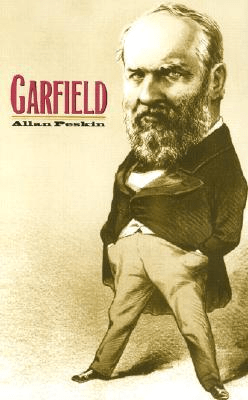
Garfield: A Biography by Allan Peskin

James Abram Garfield (named after a brother who died in infancy) was born in a log cabin in Ohio in 1831. His parents felt the death of the first James was punishment from God for not being religious, so they became Disciples (Campbellites). His father died a couple years later after catching a chill while fighting a fire.

His mother sold some land and took in sewing to make money. His 12-year-old brother Thomas worked the fields of their farm. His sisters Mary and Mehitabel (Hittie) did house work. James  was too young to be especially close to his older siblings. When neighborhood boys made fun of him for being poor and not having a dad, he was said to have “the skin of a rabbit” because he was so sensitive.

Continue reading

The Gospel of Afranius by Kirill Yeskov

This book is a response to Josh McDowell’s Proofs of the Resurrection which I haven’t read. Apparently, McDowell starts by assuming the gospels are historically reliable, then argues that every non-supernatural explanation for the resurrection of Jesus doesn’t work, therefor the resurrection must have occurred by process of elimination.

The gospels are obviously not historically reliable, but for the sake of argument, Yeskov assumes they are. He points out McDowell doesn’t account for a good-faith misbelief of an honest and sane person. As a result, there’s a whole category of non-supernatural explanations McDowell leaves out including optical illusions, hallucinations, and biases.

Continue reading

Rutherford B. Hayes: Warrior and President by Ari Hoogenboom

Rutherford Birchard Hayes was born in Ohio in 1822 a couple months after his father died of typhus. Two of his siblings died before he was born and when he was two, his brother drowned while ice skating. As a result, his mother became very protective of her two remaining children.

Rud (as he was called) was 7 before she allowed him to play with other children and 9 before she let him play sports. He was very close with his older sister Fanny who was a tomboy and superb rifle shot. They loved hunting, fishing, rowing, sailing, swimming, skating, riding, and reading. They would share irreverent jokes and puns their pious mother didn’t approve of. (Throughout his life, he never officially joined a church, although he attended services regularly.) George Washington was his hero and he would memorize patriotic speeches of famous Americans.

Continue reading

Grant by Jean Edward Smith

Grant wasn’t brilliant, especially handsome, or charming. He was an alcoholic and he wasn’t good at public speaking. He made mistakes, especially when it came to trusting businessmen. What made him successful was his honesty, his tenacity, and his reliance on others. He remained calm in battle. Once, while writing a dispatch, a shell landed near him. He only looked up briefly before he returned to writing.

Continue reading

Andrew Johnson by Annette Gordon-Reed

Andrew Johnson was born in a log cabin in 1808 in Raleigh, North Carolina. Despite being the state capitol, Raleigh was still a small town at the time. His parents were illiterate. His older sister died as a child. His father, Jacob Johnson, died soon after heroically saving three men who were in a capsized boat.

His mother, Mary (Polly) Johnson, was left to care for two boys by herself. She was a seamstress and laundress. Because Andrew had black hair and a darker complexion than his older brother William (who had freckles and light hair), there were rumors that Andrew’s biological father was a lawyer his mom did laundry for. Poor white women at the time did the same work as enslaved black women and were likewise at the mercy of the men in whose houses they worked, so the rumors are at least plausible.

Continue reading

H.L. Hunt Motive & Opportunity by John Curington

In the 1950s and 60s, H.L. Hunt was the richest man in the world. He hosted a conservative radio program called Life Line which told the world about the evils of JFK, RFK, MLK, and labor unions. He wanted to promote his radio show at the 1964 New York World’s Fair and spent millions of dollars on roller coasters and other investments, however his contract was cancelled and he lost all the money. Vice President LBJ told him the decision had been made by a “higher authority”, which Hunt took to mean President JFK. On the plane ride back to Dallas, Hunt told John Curington, the author of this book, “I’ve about got a bellyful of those Kennedy boys. They both need to go.”

Continue reading