Death by Lightning

Death by Lightning is a new four-episode series on Netflix about President Andrew Garfield (played by Michael Shannon). It’s well worth the watch. I’d say it’s historically accurate for the most part. They get a lot right, mentioning that Garfield never learned to swim, showing that he liked show tunes and chess and used to write poetry. There’s a scene of one of his sons causing chaos by riding his tricycle through the White House, which actually happened.

Continue reading

Theodore Roosevelt by Henry F. Pringle

Happy Independence Day! Last year for the Fourth of July, I wrote about Rutherford B. Hayes. Two years ago, on July 1st I wrote about John Tyler. This year, I’m writing about Theodore Roosevelt.

Theodore Roosevelt, Jr. was born to a well-off family in New York in 1858. Called Teedie, he was a sickly child who suffered from asthma and was extremely nearsighted. He read constantly and wanted to be a naturalist (he smelled of formaldehyde until he left for college). His mother once ordered the maid to clean the dead mice out of his bureau and he mourned “The loss to Science!”

Continue reading

President McKinley: Architect of the American Century by Robert W. Merry

William McKinley Jr. was born in Ohio in 1843, the seventh of nine children. He grew up in a small town with only 300 inhabitants. His father produced pig iron. His Methodist mother was opposed to slavery and encouraged education.

As a small boy, Will drove the cows to and from pasture. In winter, his feet were so cold, he warmed them up by pressing his feet in the soil where the cows had lain to enjoy the “pure luxury” of their leftover warmth.

Continue reading

Lives of the Presidents by Julian De Vries

Lives of the Presidents by Julian De Vries was published in 1940, so it only covers the presidents up to FDR, with each president getting an average of 8 pages each. He provides no citations or bibliography, so it feels like an amateur effort. Of the 30 presidents he covers, only ten of the presidents get ten or more pages (the first 7 presidents, Lincoln, Grant, and FDR), giving the impression that the most important period of American history is the beginning. He devotes 29 pages to Andrew Jackson, 21 to Thomas Jefferson, and 18 to John Adams so they must be his favorites. Four of the presidents only get 3 pages each (Pierce, Buchanan, Teddy Roosevelt, and Harding) so they must be his least favorite. Why does Theodore Roosevelt only get two and a half pages while Andrew Jackson gets 29?

Continue reading

Benjamin Harrison by Charles W. Calhoun

Benjamin Harrison was born in 1833 in his grandfather’s house in North Bend, Ohio, the second of ten children. His great grandfather Benjamin Harrison V was governor of Virginia and his grandfather William Henry Harrison was the ninth president of the United States. His father John Scott Harrison served in Congress, however, he was a farmer who was often in debt. His mother was a strict Presbyterian.

Benjamin worked on the farm as a child, and also enjoyed hunting, fishing, and reading. He attended a log cabin school built on his father’s property. When he was 14, his father sent him to Farmer’s College near Cincinnati where Presbyterian minister Professor Robert Hamilton Bishop became a powerful influence, keeping him up-to-date on contemporary political issues and instructing him in religion.

Continue reading

Grover Cleveland: A Study in Character by Alyn Brodsky

Happy President’s Day! Last year for president’s day, I did a post about Abraham Lincoln. Two years ago, I did a post about Thomas Jefferson. This year, it’s a less famous president, Grover Cleveland.

Grover Cleveland was the only Democrat to be elected president between the Civil War and World War I. His great great grandfather Aaron was friends with Benjamin Franklin. His great grandfather (also named Aaron) was an abolitionist way back in the 1790s. His father Robert was a Presbyterian minister and his mother owned a slave before her husband made her send her slave away.

Stephen Grover Cleveland was born in Caldwell, New Jersey in 1837. He was the fifth of nine children. He was named in honor of his father’s predecessor who had founded the Caldwell church. He ended up dropping the Stephen from his name, although he was known as Big Steve to his friends.

Continue reading

Gentleman Boss by Thomas C. Reeves

Chester Alan Arthur was born in 1829 in Fairfield, Vermont (although he would later list his birth year as 1830 to make people think he was a year younger). His father William had been born in Ireland. William was a Baptist preacher, a school-teacher, a magazine editor, and co-founder of the New York Anti-Slavery Society.

Chet had four older sisters and a younger brother. He was named Chester after the physician who delivered him and he was named Alan after his Irish grandfather (his middle name is pronounced the Irish way).

Continue reading

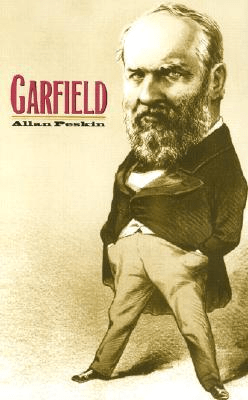
Garfield: A Biography by Allan Peskin

James Abram Garfield (named after a brother who died in infancy) was born in a log cabin in Ohio in 1831. His parents felt the death of the first James was punishment from God for not being religious, so they became Disciples (Campbellites). His father died a couple years later after catching a chill while fighting a fire.

His mother sold some land and took in sewing to make money. His 12-year-old brother Thomas worked the fields of their farm. His sisters Mary and Mehitabel (Hittie) did house work. James  was too young to be especially close to his older siblings. When neighborhood boys made fun of him for being poor and not having a dad, he was said to have “the skin of a rabbit” because he was so sensitive.

Continue reading

Rutherford B. Hayes: Warrior and President by Ari Hoogenboom

Rutherford Birchard Hayes was born in Ohio in 1822 a couple months after his father died of typhus. Two of his siblings died before he was born and when he was two, his brother drowned while ice skating. As a result, his mother became very protective of her two remaining children.

Rud (as he was called) was 7 before she allowed him to play with other children and 9 before she let him play sports. He was very close with his older sister Fanny who was a tomboy and superb rifle shot. They loved hunting, fishing, rowing, sailing, swimming, skating, riding, and reading. They would share irreverent jokes and puns their pious mother didn’t approve of. (Throughout his life, he never officially joined a church, although he attended services regularly.) George Washington was his hero and he would memorize patriotic speeches of famous Americans.

Continue reading

Grant by Jean Edward Smith

Grant wasn’t brilliant, especially handsome, or charming. He was an alcoholic and he wasn’t good at public speaking. He made mistakes, especially when it came to trusting businessmen. What made him successful was his honesty, his tenacity, and his reliance on others. He remained calm in battle. Once, while writing a dispatch, a shell landed near him. He only looked up briefly before he returned to writing.

Continue reading