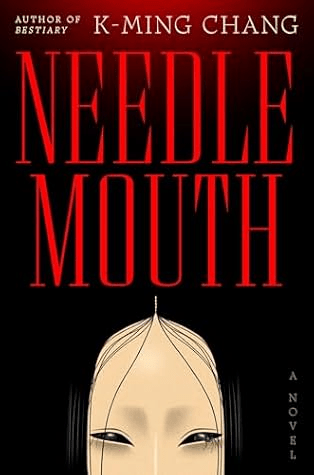
Cindy wakes each morning with something in her mouth such as a needle, a coin, or a bird. It’s delightfully weird. Just the sort of thing I like. She is living with her aunts and her cousins Mandy and Yangyang.
Cindy doesn’t remember her parents or where she came from. She comes to this house every summer, but doesn’t remember any previous summers. She discovers a room in the house she’s never noticed before. I have dreams like this, so this felt very dreamlike to me. Being in the room gives her the urge to hurt herself.
Her cousin Mandy once covered herself in excrement to repel other people. There’s actually a lot of scatological references throughout this novel, so if that sort of thing grosses you out, you probably should avoid this. Also, don’t read this if you want to avoid references to self-harm.
The novel alternates between the viewpoints of Cindy and Mandy and also includes sections told by the demon Needlemouth who has a needle for a mouth and leeches for lips. Yangyang rarely gets a viewpoint chapter and doesn’t have much of a personality. She’s rather passive and content to just follow others. Her worst nightmare is never dying, which is actually my worst nightmare as well.
When they were younger, Mandy would give Cindy impossible tasks such as picking up her shadow to test her loyalty. Like Mandy, Needlemouth gives Cindy an impossible task: to kill her father who’s already dead. It’s interesting that demons appear in the form of seagulls and live at a dump, rather than the fiery Hell demons typically dwell in.
There’s occasional alliteration and sing-songy rhyme throughout which gives the novel a playful feel, even though it’s horror. Too much of this would have gotten annoying, but I don’t think the author overdid it. There are also a few funny lines here and there, although the humor is mostly people misunderstanding one word for another such as confusing patricide with pesticide. I did enjoy the wordplay when the characters are told instead of leaving something behind, they should leave something ahead.
It feels like the novel was written with a female audience in mind. Castration is played for laughs. Mandy believes all men deserve to die. She says she would kill any boy just for existing. Cindy also says she’s always despised men. Needlemouth wants her father to die seemingly just because he’s a man. Needlemouth also thinks her mother is weak because she refused to torture an innocent boy to death. Simply being born male seems to be a crime worthy of death in the world of this novel.
To be fair, the novel takes place in a culture that considers daughters worthless, so it makes sense women in this world would hate men. However, completely reversing things and promoting the message that all men are worthless doesn’t feel like a corrective so much as a mirror image that’s just as bad as what it’s trying to critique.

