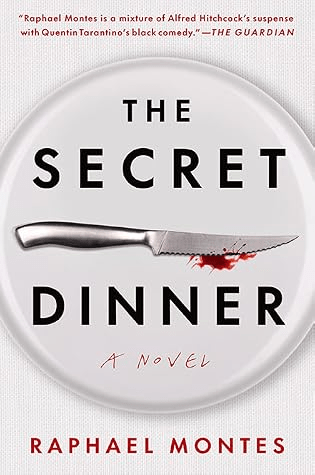
Four childhood friends leave their small town and move to Copacabana. Roommates Hugo (the chef), Dante (the narrator), Miguel (the doctor), and Piglet (the hacker) all feel like real people and interact realistically. There’s great characterization in this one.
It’s fast-paced and easy to read. Desperate for money, the roommates find themselves in a situation where they’re offering to serve human meat at a fancy secret dinner. In the beginning, it’s a bit reminiscent of a sitcom with one dumb decision quickly snowballing into another. The way the roommates get mad at each other is a bit sitcom-like as well.
It’s partly told in the form of a group text, complete with memes and autocorrect. Short poems are included throughout the book. It even includes a recipe! The book sometimes breaks the fourth wall with Dante telling us we’d do the same thing in his situation. It starts out as a dark comedy before turning into horror. It gets horrible pretty fast. Then it gets worse.
The novel makes us ask if eating a human is really worse than eating cows or pigs killed in horrific ways. A repeated theme is that eating animal meat isn’t much better than eating human meat. We lie to ourselves about happy cows living on small family farms when global production obviously can’t work that way. At a scale large enough to feed everyone, cruelty is necessary. Eating any kind of meat is monstrous.
The horror of the book comes from imagining what it would be like if we treated people the same way we treat animals. While this is a work of fiction, you can’t help thinking about the real life horror of slaughterhouses.
This book even had a surprise twist I didn’t see coming. There was one brief mention of incest which I thought was too nonchalant for such a serious subject. Except for that, I thoroughly loved this book. Highly recommended.

