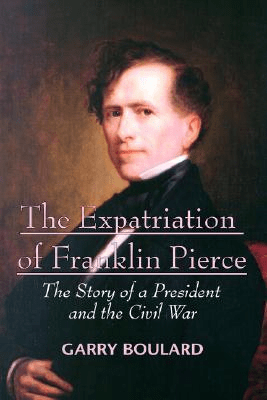
The Expatriation of Franklin Pierce by Garry Boulard

Benjamin Pierce fought in the Revolutionary War, was a sheriff, state legislator, and a local hero. However, his lack of education made him hesitate from a life of politics. He encouraged his son Franklin to be a politician. At 14, Franklin Pierce was sent to boarding school, then to Bowdoin College two years after that.

He wasn’t enthusiastic about school and came in dead last on the list of student standings his first year. He determined to do better. During the summer he made some money teaching. When he returned to college, he formed a marching unit. Younger students Nathaniel Hawthorne and Henry Wadsworth Longfellow drilled under his command and became friends with him.

Continue reading

Pyrotechnicon by Adam Browne

“That I have left my tales intact, complete with imperfections, serves not as proof of my dishonesty, but the opposite! Any blame lies not with the poor author who writes with the strictest regard to honesty, but with the events themselves.”

Pyrotechnicon is a fantastical, whimsical novel in which Cyrano de Bergerac has to face off against a man who’s part billiard table, a giant microscopic organism, a house made of birds, and other fantastical wonders. It’s pre-steampunk science fiction based on 17th century scientific ideas taken to their logical conclusions.

Continue reading

Again, Dangerous Visions edited by Harlan Ellison

Again, Dangerous Visions, published in 1972, was the follow up to the successful anthology Dangerous Visions. Each story has an introduction written by Ellison and an afterword written by the author. In some cases, the introduction and afterword are longer than the story itself.


In many of the introductions, Ellison tells us a third anthology in the series titled The Last Dangerous Visions is going to be published soon, and even shares the names of some of the authors who will appear. Alas, this third volume was never published during his lifetime. I get the impression Ellison wanted to include every prominent science fiction author of the time in these three volumes, but wasn’t able to pull it off since new writers kept coming along. (Ellison’s executor, J. Michael Straczynski, announced plans to publish a slimmed-down version of The Last Dangerous Visions in 2020, but it still hasn’t seen the light of day as of this writing.)

Continue reading

Millard Fillmore by Kevin J. Law

Millard Fillmore was born in 1800 in a log cabin to a poor tenant farmer in New York. He was named Millard after his mother’s maiden name. His father and uncle had been sold a land title sight unseen. The land turned out to be hard clay not good for farming. On top of that, the title was faulty and they lost the land. They ended up moving a few miles south where the land wasn’t much better.

Fillmore grew up doing farm chores. He had four brothers and four sisters. His father considered hunting and fishing (“sporting”) to be a waste of time. When Fillmore was 14, he was apprenticed to an ill-tempered cloth maker. He quit after 4 months, but his father found him another cloth-making apprenticeship that he stayed at for years.

Continue reading

Do Androids Dream of Electric Sheep? by Philip K. Dick

The novel Do Androids Dream of Electric Sheep? is similar to the movie Blade Runner which was based on it, but also very different. Rick Deckard is married rather than single and surprisingly, owns an electric sheep. Since animals are nearly extinct, owning one is a status symbol. Those who can’t afford a real animal, buy electronic facsimiles. Due to the lack of animals, everyone on earth is a vegetarian through necessity and eating meat is considered atrocious.

Deckard, like most men, wears a lead codpiece to keep the radiation in the atmosphere from making him infertile. Most humans have left for the colonies, so Earth is nearly empty. Radiation has turned some people into mutants called specials. (In addition to Deckard, the other major viewpoint character is John Isidore, a special with diminished mental capacity who’s not allowed to go to the colonies.)

Continue reading

Zachary Taylor by John S. D. Eisenhower

Taylor was born in Virginia in 1784, not far from the home of his distant cousin James Madison. His father was an officer in the Revolutionary War and was head of one of Virginia’s prominent families. However, his family moved to Kentucky shortly after he was born.

He was a wealthy plantation owner, a gentleman farmer, businessman, slave holder, and soldier. There were apparently skirmishes with Native Americans early in his career that are largely unreported. A lot about Taylor has been lost since his personal papers were destroyed in the Civil War (his son was a major general in the Confederate Army).

Continue reading

Polk: The Man Who Transformed the Presidency and America by Walter R. Borneman

James Knox Polk was born in 1795 in a log cabin in North Carolina, within twenty miles of Andrew Jackson, who was 28 years older. His family was Presbyterian, but his grandfather became a deist and Polk himself wasn’t baptized due to his father getting into an argument with the local minister. His family moved to Tennessee in 1806.

Young James was sickly due to urinary stones. In 1812, when he was 17, he survived surgery to remove the stones. He started attending the University of North Carolina when he was 20. At the time, the university was staffed by a single administrator, a single professor, and a few tutors. He graduated in 1818, but was too frail to travel home right away.

Continue reading

The Far Reaches

The Far Reaches is a collection of six short stories available for free for Amazon Prime subscribers. All of the stories take place in space. Colonization is a theme in half the stories. We get a wide variety of narrators including an AI, an alien, a human raised by aliens, and a clone. There’s a cozy science fiction story and an engaging murder mystery aboard a space ship. They’re all written by famous science fiction writers. I liked all of them, but my favorites are the stories by Rebecca Roanhorse, Veronica Roth, and James S. A. Corey.

Continue reading

William Henry Harrison by Gail Collins

William Henry Harrison grew up in a Virginia mansion (although when he later ran for president, he claimed to have grown up in a log cabin). He was the youngest of seven children. His father was a governor of Virginia and a signer of the Declaration of Independence. His mother was a relative of Martha Washington and also came from a wealthy family.

During the Revolutionary War, the family mansion was sacked (the British took 40 of the family slaves and also stole furniture and livestock) and the overused soil was beginning to produce fewer crops. Harrison therefore didn’t attend William and Mary like his brothers, but rather the less expensive Hampton-Sidney College. He then went to the Medical School of Pennsylvania. His father died when he was 18 and the family couldn’t afford to continue schooling him, so he joined the army.

Continue reading