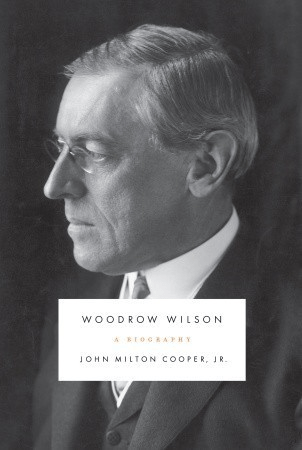
Thomas Woodrow Wilson born was born on December 28, 1856, in Staunton, Virginia. He was the third child and first son of Reverend Joseph Ruggles Wilson, minister of First Presbyterian. Reverend Wilson was a heavy smoker, scotch drinker, and billiard player. He was outgoing, witty, and fond of puns. (Woodrow Wilson himself didn’t smoke, but had the occasional scotch.)
Like his mother, Tommy had blue-gray eyes that changed color with his mood. In 1857, his father was called to Augusta, Georgia and the family had slaves to serve them leased by the church. His father got an honorary doctorate and went by Dr. Wilson thereafter.
Tommy was four when the Civil War broke out. Not only did southern states leave the union, but southern Protestants also seceded from their national organizations. Dr. Wilson was a high ranking member of the Confederate Presbyterians. However, two of his brothers were Union generals and his father was anti-slavery. He never reconciled with his family after the war. Tommy didn’t get to know his Wilson relatives until he was a grown man.
As a boy, Tommy was dignified and very orderly. He was a careful horseback rider. He played baseball and enjoyed cockfighting. He had trouble learning to read, not reading comfortably until he was 12. In 1873, at the age of 16, he entered Davidson College in North Carolina. It was a small college with only 100 to 150 students. Students had to draw their own water, cut their own wood, and light the fire in their room. Wilson was a good student except in math. He was part of the literary and debating society, and played on the baseball team. He only attended for a year, then spent a year with his family, then went to Princeton when he was 18.
At Princeton he continued playing baseball. He was a fan of football, although he didn’t play. He joined an “eating club” called the Alligators. (Since fraternities weren’t allowed, eating clubs took their place.) He debated politics and wrote for the campus newspaper.
He next went to the University of Virginia Law School where he encountered lifelong rival William Cabell Bruce who beat him at debate. He didn’t care for law, wanting to study politics instead, but his father pushed him to become a lawyer. Tommy started going by Woodrow in his twenties.
He fell in love with his first cousin Harriet (Hattie) Wilson and got in trouble for skipping class to attend her graduation from the nearby Augusta Female Seminary. A year or so later, he proposed marriage, but she declined due to them being too closely related.
He published articles and wrote a book about government, but failed to get it published. He passed the bar. Unlike most, he didn’t study under an established lawyer, instead relying on his own learning. He began practicing law in Atlanta. However, he and his friend Edward Renick got hardly any cases. Renick’s friend, the reporter Walter Hines Page, arranged for Wilson to testify before the Tariff Commission and praised his argument for a tariff for revenue only.
Wilson got his first typewriter in 1883. It was expensive. Typewriters were new and didn’t yet feature a standard keyboard. He also fell in love again, this time with Ellen Louise Axson who he saw in church. She was the daughter of a Reverend who was friends with his father.
Ellen had a reputation for being a “man-hater” for turning down three previous proposals. She excelled at math and foreign languages, drawing, and painting. She led her class at Rome Female Seminary in Georgia and wanted to continue her education, but her father couldn’t afford to send her to college.
Wilson decided to leave law and go back to school at John Hopkins to become a professor. He planned to meet Ellen in North Carolina, but her father became ill and she decided to return home. Her letters to Wilson about the change of plans were lost. However, they met by coincidence while she was waiting for her train and he happened to see her at her hotel in Asheville. He convinced her to postpone her trip and they spent a couple days together. He then proposed and she said yes. They were engaged for nearly two years before getting married.
He wrote a book called Congressional Government when he was 28, his first and most successful book. It has stayed in print for over a century. In 1884, his fiancé’s father died in the state mental hospital, probably by suicide. Ellen inherited enough money for her brother to go to college and for her to study with the Art League in New York. Wilson didn’t like that this postponed their marriage, but as he was still in school himself, he couldn’t really object.
In 1885, Wilson and Ellen married. His father and her grandfather jointly performed the ceremony. He also accepted an offer to teach history and political science at a new women’s college called Bryn Mawr. He would have preferred to teach men, but this was the opportunity that presented itself. There wasn’t much privacy at the faculty house, so Ellen went to her aunt’s house in Georgia to give birth to their daughter Margaret. When summer came, Wilson joined her and met his daughter for the first time. A second daughter followed soon after. Ellen’s eleven-year-old brother Eddie and her cousin Mary Hoyt, who would attend Bryn Mawr, also joined their household.
In 1888, he got an offer to teach at Wesleyan University at an increased salary. He accepted and broke his contract with Bryn Mawr, threatening to sue them if they wouldn’t let him go. He was finally able to teach men. He used a textbook he’d written in his lectures and coached baseball and football. Ellen’s brother Stockton moved in with them and became an English student at Wesleyan. They had a third daughter. The pregnancy was difficult, so they decided not to try for any more children.
Wilson really wanted to teach at Princeton. His friends and wealthy classmates advocated on his behalf and he eventually got the offer. He thrived there. Students loved him. He won most popular professor in a student body poll six years in a row. He served on several committees and continued writing books and making speeches. He was given job offers to be president of other universities which he used as leverage to get a raise from Princeton. He played tennis and bicycled. He told his daughters stories, doing Irish and African American accents. Nell was his favorite daughter. The two liked to play tag and engage in hijinks.
Wilson occasionally had digestive problems, a common remedy at the time was to use a stomach pump to remove acids and inject small amounts of coal. In 1896, he suddenly experienced severe pain and numbness that made him barely able to use his right hand. He went to England for a couple months rest cure after which he was able to use his right hand again.
He gave a speech at Princeton’s sesquicentennial attended by President Cleveland that was a huge success. In 1896, he met Theodore Roosevelt and the two hit it off. He was a fan of Rudyard Kipling, carrying his poem “If” in his wallet for years. Wilson wrote a biography of George Washington and a history of the United States which made him quite a bit of money. When the president of Princeton resigned, he recommended Wilson as his replacement and the trustees unanimously agreed.
He was inaugurated in 1902. He was Princeton’s thirteenth president, but unlike most at the time, he considered 13 his lucky number because it was the sum of the number of letters in his first and last names. The inaguration was attended by ex-president Grover Cleveland (Roosevelt was unable to attend due to an injury, but wanted to), Robert Todd Lincoln, J. P. Morgan, the former Speaker of the House, novelists and magazine editors. Unlike the sesquicentennial which was attended by only white men, Wilson invited three representatives from women’s colleges and Booker T. Washington. (One of Ellen’s aunts said she wouldn’t have attended if she knew a black man would be there.)
As president, he fundraised and grew the school. He abandoned the Presbyterian orthodoxy and hired Princeton’s first Jewish and Catholic faculty members. He continued to teach classes as president so as not to lose touch with the students.
In 1905, Ellen’s brother, his wife, and their young son died in a ferry boat accident. Ellen fell into an intense depression for months which she never fully recovered from. In 1906, Wilson woke up to find he was blind in his left eye due to a hemorrhage. Ophthalmologists recommended rest. He returned to England and eventually regained partial vision.
His friend, the editor of Harper’s Weekly, said he should be the leader of the Democratic party. Wilson then gave a speech that went over well to the New York Democratic Club. In 1907, he was nominated for US Senator, although it was a largely ceremonial nomination since Democrats were in the minority and not likely to get elected.
He started to lose popularity at Princeton by suggesting an overly ambitious plan to make too many changes too quickly, including doing away with clubs. It also led to him losing his best friend Jack Hibben who would be Wilson’s successor as president of Princeton years later. In 1907, his daughter Jessie returned from college a suffragist, but Wilson remained opposed to women gaining the right to vote. Also in 1907, his right hand again became numb and painful and he took time off to rest. This time, he went to Bermuda where he met Mark Twain and engaged in his usual hobby of bicycling.
In Bermuda, he also grew really close to Mary Allen Hulbert Peck who he would continue to visit in person until 1910 and write letters to for five years after that. It’s unknown whether this relationship was more than a friendship or not. Theodore Roosevelt, who later became Wilson’s bitter rival, didn’t think Wilson was good-looking enough to have an affair. Roosevelt said, “You can’t convince the American people that a man is a Romeo who looks so much like the apothecary’s clerk.”
Back at Princeton, he fought with the dean of graduate affairs over the location of the Graduate College. Wilson wanted it in the heart of campus, while the dean wanted it off campus so it could be more like a club. Wilson didn’t think a college should be like a country club where wealthy elites kept common people out and spent more time socializing than learning. The trustees ultimately voted to build it off campus by a golf course.
Wilson gradually became less conservative and more progressive during his final years at Princeton. However, he was still opposed to interracial marriage and didn’t think black people should get prominent government posts. He also discouraged black people from applying to Princeton.
Despite being a political outsider, he got the Democratic nomination for governor of New Jersey because the political bosses thought they could control him. They visited him a few days later in his book-lined study. One asked him if he read all the books. Wilson replied, “Not every day.”
On the campaign trail he was a bit stiff and formal at first. He spoke more like a professor than a politician. Towards the end of the campaign, the board of trustees forced him to resign as president of Princeton. He was planning on retiring anyway, but was planning to wait until after the election.
He won the election by a large margin. Sugar Jim Smith, who helped get him elected, wanted to be a senator, but a different man had won the non-binding primary. Wilson was sympathetic, but said he’d stand by the primary results. Standing up to the political machine brought him good publicity. New Jersey didn’t have a governor’s mansion then, so the Wilsons lived at the Princeton Inn at first before they found a house to rent.
He worked with Republicans to institute reforms even though the Democrats didn’t like him reaching across the aisle. He had an open door policy as governor, never turning away a caller. During his first year, he was able to get the state legislature to pass almost all his bills using publicity, persuasion, and patronage. The one bill that didn’t get passed was to ratify an amendment to the constitution to allow income tax, but that passed later. The Republicans won both houses in the next election and didn’t work with Wilson, so he didn’t get much done the rest of his time as governor.
Presidential nominees tended to come from New York or Ohio, however the governors of those states were on the conservative side of the Democratic party and there was a lot of support for progressives at the moment. Wilson had become a main contender for the nomination when he was elected governor of New Jersey. It helped that he had friends in other states and was well-known from his speeches and his writing. When he was out-of-town, his wife Ellen learned William Jennings Bryan would be in Princeton. She telegraphed for Wilson to return home immediately and invited Bryan over for dinner. Bryan was a leading figure in the Democratic party at the time and this meeting helped secure Wilson’s nomination.
On the Republican side, Theodore Roosevelt had decided to run against his own hand-picked successor William Howard Taft. This created a rift in the Republican party which almost guaranteed a Democrat would win the presidency. However, the Speaker of House Champ Clark was also running for the Democratic nomination and it looked like he would get it. He initially led at the convention and Wilson was ready to concede. However, behind-the-scenes wheeling and dealing finally got Wilson the nomination.
Theodore Roosevelt had started his own party, so three men were running for president in 1912. Wilson spoke extemporaneously rather than writing speeches in advance which opened him up to being mischaracterized. Roosevelt, on the other hand, provided copies of his speech to reporters beforehand so he couldn’t be misquoted. Reporters were surprised upon meeting Wilson that he was more down-to-earth, humorous, and prone to cussing than they expected. When someone tried to assassinate Roosevelt and he had to stop campaigning, Wilson also suspended his campaign out of respect.
W. E. B. DuBois endorsed Wilson, claiming he wouldn’t dismiss black men from office. Wilson responded that he would be fair to black Americans. Roosevelt was in favor of women getting the right to vote but Wilson said it was up to the states. Other than this, their policies were hard to tell apart.
Motion pictures were new at the time and Wilson’s campaign made a campaign film. Wilson overwhelmingly won both the popular vote and the electoral college. Democrats got the majority in the House and Senate and won additional governorships. Woodrow Wilson was the only professional academic with a PhD to become president.
Wilson went back to his hometown of Staunton, Virginia while president elect. The only relative still living there was an elderly aunt who asked what he was doing now. He said he was elected president. She asked, “President of what?” Apparently, she didn’t follow the news.
Wilson hit the ground running. Congress typically didn’t convene until December, but Wilson called for them to convene in April, just weeks after his inauguration. Instead of letting congress take the lead in proposing and drafting new legislation, Wilson took the lead.
He was in favor of conservation and would end up establishing the National Park Service. He also wanted banking reform, lowering the tariff, and anti-trust laws. Lowering tariffs would reduce government revenues and required the passage of an income tax for the wealthy. The 16th Amendment, which would instute an income tax, was just awaiting ratification by three quarters of the states. One of his last acts as governor of New Jersey was getting them to ratify the 16th amendment.
Wilson enjoyed going to the theatre, going to movies, golf, and taking long drives (although he never learned to drive himself.) In 1912, two of his daughters got engaged but kept it secret from the press. He was one of the last presidents to write his own speeches and the first president to hold press conferences. He was comfortable delegating to his department heads, assuming they knew more than he did.
More than half his cabinet came from the South as did nearly all the congressional leadership. Many southerners didn’t like black people being supervisors of white people. Wilson allowed his cabinet members to segregate the Post Office, Treasury Department, and the Bureau of Printing and Engraving. Wilson lowered the number of black people in government positions.
His new physician, Cary Grayson, got him to stop eating charcoal and pumping his stomach. The two became friends and often golfed together. Wilson never became a good golfer, possibly due to impaired vision in his left eye.
For the most part, Wilson appointed Democrats to government office replacing the Republicans who held the post, though he did use the merit system rather than the spoils system to staff the consular service and subministerial foreign service.
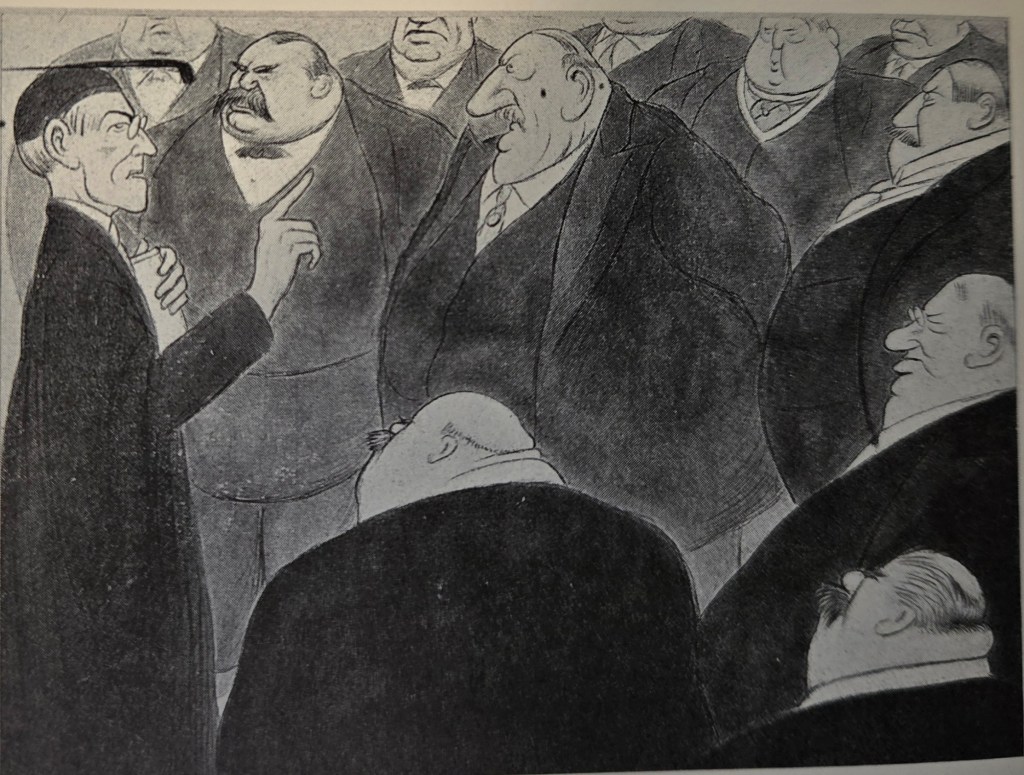
Wilson pushed several programs through Congress know as the New Freedom during his first term. He broke tradition by speaking to Congress in person. He kept Congress in session longer than any president before, a continuous eighteen months. Political cartoonists often depicted Wilson in cap and gown or as a schoolmaster with Congress depicted as schoolboys chained to their desks.
The first order of business was lowering the tariff. The House approved, but the Senate was opposed. Wilson put public pressure on and agreed with the Republican’s suggestion to investigate. Senators had to disclose their stock and land interests that were affected by the tariff. How much lobbyists paid them was revealed as well. The tariff bill passed, including an income tax for the wealthy.
He passed the Federal Reserve Act to reform the banking system and create the Federal Reserve. He also passed the Clayton Anti-Trust Act and established the Federal Trade Commission to prevent monopolies. However, the FTC didn’t become powerful enough to have a strong impact until the 1930s.
On the foreign affairs front, California passed a law forbidding Japanese immigrants to own land. There were reports of Japan preparing for war, but cool heads on both sides prevented that from happening.
There was a bloody coup in Mexico after which general Huerta overthrew president Madero. American businessmen and the American ambassador were in favor of the coup, but Wilson issued a statement condemning government by force rather than by law. Many Americans lived in Mexico, so there was pressure to intervene to protect both American lives and American economic interests.
Huerta dissolved congress, arrested most of them, and made himself dictator. The British ambassador to Mexico supported him. (Britain had oil interests in Mexico.) Wilson met with a British Foreign Office official and in exchange for doing away with Panama Canal tolls, the British withdrew their support for the dictator. Wilson lifted the arms embargo against the Constitutionalists in Mexico, but they failed to overthrow Huerta.
In April 1913, Mexican troops arrested American sailors. They were quickly released, but Wilson used this as a pretext for military action. He sent troops into Veracruz to prevent Huerta from getting an arms shipment. Nearly 200 died. He could have done a blockade instead. Huerta resigned and Carranza took over.
Wilson intervened in Nicaragua making it briefly peaceful. He occupied the Dominican Republic in 1914 and the US didn’t leave for ten years. He also occupied Haiti and the US didn’t leave until 1934. He helped to start ending the occupation of the Philippines. He vetoed an anti-immigration bill, but Congress overrode him.
Ellen began to exhibit her paintings in 1912. She signed her paintings E. A. Wilson and used the name Edward Wilson with dealers so no one would know it was the first lady. Their daughter Margaret was pursuing a musical career and Jessie got married in the White House. Woodrow’s favorite sport was baseball and he continued Taft’s custom of throwing out the first ball at the opening game of the Major League season.
In 1914, Ellen’s health grew poor. Also their youngest daughter Nell broke off her engagement with her previous suitor because she’d fallen in love with fifty-year-old secretary of the Treasury William Gibbs McAdoo who was almost as old as her father. He had seven children from his first marriage, two of them older than Nell. Her parents agreed to the engagement, however, due to how madly in love they were.
Shortly after Nell married, Ellen died of Bright’s Disease. While she was on her deathbed, she asked Wilson if he could get Congress to act on her plan to clean up Washington’s alleyways. He arranged for both houses to quickly pass the bill and told her the good news that afternoon.
Meanwhile, World War I had gotten under way. The US remained neutral at first, but Wilson needed to help Americans stranded in Europe. The war disrupted trade and hurt the economy at first, but a few months later, orders for military products and agricultural commodities boosted America’s economy, a boom that would last into the next decade. He initially banned banks from loaning money to countries at war since it was inconsistent with neutrality and would cause the war to last longer, but he changed his mind shortly afterwards.
Wilson was known for his self-control. When he got really mad, he’d give you the silent treatment. His close friend and brother-in-law Stockton Axson once wrote, “The silence of Woodrow Wilson is worse than the oaths of some men, more withering.” He did occasionally lose his temper as when a delegation of black people met with him regarding their opposition to segregation. Wilson didn’t like their tone so he yelled at them and kicked them out.
Wilson’s classmate Thomas Dixon wrote a novel titled The Clansman that glorified the Ku Klux Klan. It was turned into a movie titled Birth of a Nation. The NAACP protested against it. To gain publicity, Dixon asked if he could show the movie at the White House. According to someone who was there, Wilson didn’t say anything about the film, but 22 years later, a magazine writer claimed he liked it and said, “It is like writing history with lightning.” Wilson said he didn’t know what the movie was about before he saw it and did not endorse it, although he didn’t outright condemn it either.
Wilson’s physician and golfing buddy Cary Grayson thought Wilson’s cousin Helen Bones was lonely living in the White House after Ellen died. He asked his friend, the widow Edith Bolling Galt, to spend time with her. Wilson fell in love with Edith at first sight. She had only one child who died shortly after birth. She became a jewelry store owner when her husband died. She played golf and was the first woman in Washington D.C. to get a driver’s license. She had an eye for fashion and loved to travel.
He proposed to her less than a year after his first wife died, which wasn’t considered a proper amount of mourning time. She initially said no, but it was customary for a well-bred woman to deny the first proposal. They continued their courtship under the watchful eye of the Secret Service. Like his first wife, she would soon become Wilson’s closest advisor and would later accept his marriage proposal, although they kept it secret at the time. He would share secrets of state with her.
On May 7, 1915, a German torpedo sank the Lusitania, killing 1,198 people including 128 Americans. People were outraged, but few called for war. Wilson demanded an apology and reparations. He negotiated with Germany for almost a year trying to be firm, but also trying to avoid war. Secretary of State William Jennings Bryan was worried Wilson’s tough stance toward Germany would led to war and so he resigned.
Wilson called for strengthening the army and navy so Germany would start taking him more seriously. The Germans sank another British liner called the Arabic with Americans on board. Wilson leaked to the news that he was considering breaking off relations with Germany and Germany promised to stop sinking liners. They sunk another one a few weeks later, but no Americans were on board. Germany eventually agreed to pay an indemnity for the Arabic.
On the same day Wilson announce his engagement to Edith, he also expressed support for female suffrage. They got married December 1915. It was a small wedding at Edith’s house with only family members. They took a train to Hot Springs, Virginia for their honeymoon. When the train pulled into the station the next morning, a Secret Service agent saw Wilson dancing a jig, clicking his heels in the air, and singing the vaudeville tune, “Oh you beautiful doll! You great big beautiful doll!” The wedding night apparently went well.
He had to cut his honeymoon short when news reached him that Germany had sunk another British liner, the Persia, with Americans on board. The Germans apologized for the sinking and finally acknowledged liability for sinking the Lusitania.
Anti-war sentiment was strong and there was a lot of opposition to Wilson’s military build-up. He went on a speaking tour, explaining he wanted peace, but we had to prepare a good defense because the world was on fire. He got his increased military spending approved. Wilson tried to negotiate peace between Britain and Germany, but failed to do so.
On March 9, 1916, Pancho Villa attacked Columbus, New Mexico killing 7 soldiers and 8 civilians. 67 Mexicans were killed. It was the first attack on American soil since 1812. Wilson sent the military into Mexico to track down Villa. This was known as the Punitive Expedition. More clashes and killing ensued over the next several months.
Members of the cabinet didn’t think Wilson was acting forcefully enough, but Wilson resisted the pressure to go to war with Mexico. “I shall be held responsible for every drop of blood that may be spent in the enterprise of intervention.” When he ran for reelection, his slogan was “He kept us out of war” mostly referring to Mexico, but also to World War I.
He appointed Brandeis to the Supreme Court, the first Jew to hold such a high political office. While running for reelection in 1916, he got Congress to pass a workman’s compensation bill, a child labor bill, and eight-hour workday for railroad workers. Republicans lied about Wilson during the election, claiming he killed his first wife by pushing her down the stairs and claiming he secretly told Germany not to take his protests seriously. Since big business was on the Republican’s side, it looked like they might win.
A German submarine had sunk six Allied merchant ships near Rhode Island. If Wilson lost the election, he thought it would be disastrous for him to remain president for four months until inauguration since he would be a lame duck. If that happened, he decided he would appoint president-elect Hughes Secretary of State, then he and the Vice President would resign, making Hughes become president immediately rather than wait four months for inauguration day.
When the returns started to come in, The New York Times declared Hughes the winner. However, after all the votes were counted, Wilson had won. The election came down to California which Wilson barely won by 3,806 votes out of nearly a million. It was one of the closest elections in US history.
Despite Wilson calling for peace, Germany thought America was going to declare war soon. Germany decided to stop all sea traffic, both Allied and neutral, with submarines. Since Britain’s financial trouble was about to lessen their munitions, Germany could have won the war if they hadn’t done this, but they didn’t know Britain’s financial situation. Instead, they brought America into the war, which caused Germany’s defeat.
German submarines attacked American merchant ships. Wilson agreed to arm merchant ships and broke off diplomatic relations with Germany, but he still hoped for peace. Germany sent a telegram to Mexico promising them the land they lost during the Mexican American War if they’d attack America. Britain intercepted the Zimmerman Telegram and Wilson released it to the press. This further fueled anti-Germany sentiment, but many in Congress still hoped to avoid war.
Wilson eventually called for war, but noted it wasn’t with the German people, but their autocratic leaders. He arrived at this decision after spending time thinking by himself like usual. This is how he arrived at decisions. He probably spent more time alone than any other president.
Once he decided to go to war, he went all in. He raised two thirds of the money needed for war with Liberty Loans. These were extensively advertised including rallies featuring celebrities like Charlie Chaplin and Ty Cobb. He called for a draft. He took over the railroads for military use. He asked farmers to grow crops other than cotton for the war effort. Roosevelt asked to lead a volunteer division, but Wilson declined. He wanted a well-trained army rather than a gaggle of volunteers.
Wilson wanted to keep his distance from the Allies. They were both fighting Germany, but the Allies wanted a victory, while Wilson wanted “peace without victory”. If one side was utterly defeated, that would just make them want revenge later.
The draft contained exceptions for farmers and workers in industries critical to the war effort. Heavyweight champion Jack Dempsey took a job in a shipyard to dodge the draft. In the South, black men were disproportionately drafted. Anti-war sentiment could hurt the war effort. Publications deemed disloyal couldn’t use the mail. Wilson wanted censorship of the press to go further, but Congress blocked him.
There began to be discrimination against German Americans. There was at least one lynching. Municipalities banned teaching German. There was book burning of German authors and orchestras banned Mozart, Beethoven, and Brahms. Wilson ignored requests for him to speak out against this.
The Industrial Workers of the World (known as the Wobblies) tried to unionize loggers, miners, and migratory farm workers. In Bisbee, Arizona, 1,000 Wobblies were put in cattle cars and dumped in the middle of the desert without food or water. In Butte, Montana, Wobbly organizer Frank Little was tortured and murdered. The Wobblies threatened strikes. Wilson didn’t want to make them martyrs, but trusted the people he delegated to who moved to crush the Wobblies.
German submarines sank half a million tons of Allied supplies every month, but Britain was reluctant to use the convoy system whereby destroyers would escort merchant ships. Wilson put this into practice and convinced the British to do the same. Submarine attacks lessened. He also ramped up ship building efforts, employing nearly 400,000 workers who launched nearly 100 ships a day.
Wilson choose Herbert Hoover as his food administrator. To preserve certain types of food for soldiers and allies, he promoted wheatless days and meatless days. Eating certain categories of food sparingly was called “Hooverizing”. People who signed a pledge to conserve food were given buttons and stickers. People were encouraged to plant vegetable gardens and to raise sheep and knit scarves and mittens for the troops. Edith Wilson planted a “war garden” and Woodrow Wilson brought in sheep to graze on the South Lawn of the White House.
Black people from the South moved North due to the rising demand for workers. This led to a race riot in East St. Louis that left 39 black people and 9 white people dead. Wilson wanted to do something about it, but he deferred to his Attorney General who said it wasn’t a federal matter. In Houston Texas, a conflict killed 15 white people and 3 black soldiers. The army executed 13 black soldiers immediately, sentenced 41 to life in prison, and sentenced 16 more to death.
At one camp in Virginia, black soldiers were denied blankets, fresh clothes, bathing facilities, and medical treatment. Many died. The NAACP protested the race riots and read a petition to Wilson asking for a full investigation into the Houston affair. Wilson commuted the sentences of some of the men, saving their lives.
Nearly 100 black people were lynched in 1917 and 1918. Robert R. Motion, principal of the Tuskegee Institute, asked Wilson to condemn the act. Wilson gave a speech condemning lynching. If he hadn’t ignored the requests to do so years before, it’s possible he could have saved some lives.
Wilson disapproved of shows of passion and loved to quote Kipling’s line about keeping your head while others around you lose theirs. He opposed lynching not because he sympathized with black victims, but because he thought the shows of passion by those doing the lynching was shameful and undignified.
At this time, suffragettes were picketing the White House, chaining themselves to the fence, and disrupting traffic. Hundreds were arrested. As suffrage gained more support in the states, Wilson came to support it more. He urged congress to pass the amendment over the next few years until it finally passed in 1919 and got ratified by the states in 1920.
With the war on, free time was at a premium, but Wilson managed to find time for golf, horseback riding, vaudeville shows, playing records and teaching his wife the jig step, and attempting (but failing) to teach his wife to ride a bike. He didn’t generally like to work on Sunday and was offended whenever someone took the Lord’s name in vain.
Russia signed a treaty with the Germans in the spring of 1918. The Germans could now focus entirely on the Allies. This also caused anti-Socialist sentiment in America. Congress passed the Sedition Act further limiting freedom of speech. 113 Wobblies were convicted on trumped up charges. People who were anti-war were convicted, including Socialist party presidential nominee Eugene Debs.
Newly arriving American soldiers reinvigorated the Allies who had become depleted by the war. The Central Powers began to collapse and retreat. Germany reached out to negotiate for peace. Wilson was receptive. He didn’t want the Allies to ravage Germany the way Germany had ravaged them. But Republicans in congress wanted a complete crushing defeat instead of a peace without victory. England, France, and Italy also called for harsh terms for an armistice.
Republicans won congressional majorities in the 1918 elections, which made things harder for Wilson. Roosevelt wrote to foreign leaders and told them to disregard Wilson and impose a harsh peace on Germany. The Armistice occurred six days after election day. If it had happened sooner, the Democrats might have retained control of Congress.
Wilson had come up with a Fourteen Point Plan for peace after the war, including a League of Nations. Armistice took effect November 11, at 11 o’clock. It was the second shortest war in American history, but the third deadliest with regards to American troops. Wilson’s Fourteen Points and calls for a healing peace shortened the war, saving hundreds of thousands, if not millions of lives.
WW2, on the other hand, lasted longer because the Allies were fighting for unconditional surrender rather than a restoration of peace. Some blame WW2 on Germany wanting revenge for being punished too much after WW1, while others blame it on Germany not being punished enough by a more total defeat.
Wilson arrived in Europe for the peace conference on December 13, which he considered good luck because it was his lucky number. He and his wife would travel throughout France, England, and Italy for months to meet with people and lay the groundwork for the conference. He was the first president to leave the country while in office and the only president to stay away for so long.
This was perhaps the most busy time of his life. He worked several 15-hour days attending meetings and writing drafts. The treaty ultimately presented to the Germans was harsher than Wilson thought it should be, but it was the best he could get the Allies to agree to. His health began to fail him.
In America, former president Taft praised the League of Nations. He had proposed something similar. However, most Republicans were opposed. Wilson had his work cut out for him to get the Republicans to agree.
The summer of 1919 was known as the Red Summer due to the race riots. More than 100 were killed and thousands were injured. Homes and stores went up in flames. Violence broke out in neighborhoods less than a mile from the White House. There were also strikes, unemployment, inflation, and a full on Red scare that year. Wilson didn’t do much about any of it as his health continued to deteriorate.
When he wasn’t resting, he was meeting with senators, trying to get them to approve the League of Nations. To drum up support, he went on a speaking tour. He liked to go directly to the people and sway public opinion so the senators would have to change their mind. “I can predict with absolute certainty that, within another generation, there will be another world war if the nations of the world – if the League of Nations – does not prevent it by concerted action.”
Wilson got more frequent and longer lasting headaches. He had facial ticks and felt nauseous. The speaking tour was canceled early. When he got back to the White House, he suffered a stroke. His left arm and leg were completely paralyzed and the left side of his face drooped.
Edith became Wilson’s gatekeeper. She read the papers that came into his office and decided which ones to pass on to her husband. She barred most people from seeing him. This was in line with the medical thinking at the time that it was best to isolate stroke victims from outside contact as much as possible.
Many people believed she had become the de facto president. She did make the decision to veto the Volstead Act (which enforced Prohibition), although Wilson would have agreed. Congress overrode the veto, so it didn’t end up mattering anyway. Edith was Wilson’s closest confidant and knew his mind better than anyone else.
Secretary of State Lansing tried to have Wilson replaced by the vice president, but the vice president resisted attempts to put him in charge without Wilson’s approval. Wilson slowly recovered and was able to have a few meetings. He also went out to the White House lawn in a wheelchair.
By the end of 1919, bombs were exploding at the homes of public officials. In response, Attorney General Palmer blamed the “Reds” and had 249 people deported to Russia.
An American was detained in Mexico and there were cries for military involvement. The senate voted to have a couple senators discuss the situation with the president. They really wanted to check if he was as healthy as he was claimed to be. The senators were called the “smelling committee.”
They were escorted to his bedroom. The extent of his disability was hidden from them. He covered his paralyzed left side with blankets. Papers were on a table to the right of the bed where he could reach them with his good hand. During this meeting, the American was released from Mexican custody.
The senators reported that Wilson seemed physically and mentally fit and talk of removing Wilson ended there. However, his mind wasn’t as sharp as it had been. He eventually was able to stand up and take a few steps. As a result of his illness, he began to have uncharacteristic mood swings and became very stubborn. He refused to comprise with Congress leading to a stalemate regarding the treaty. The US never ratified the treaty and never joined the League of Nations.
His last year in office was rough. He ignored calls to pardon people convicted of dissent during the war. He didn’t do much, letting his cabinet members do their own thing. During one of his limo rides, he became obsessed with trees being cut down in Rock Creek Park and called the Superintendent a liar when he said only dead trees were being cut down. He became delusional and thought he could win a third term as president.
The 1920 Democratic convention was the first to be held on the west coast (in San Francisco), the first to use microphones, and the first broadcast on radio. Wilson was devastated when he didn’t get the nomination, even though there was no chance of this happening.
He became forgetful and flew into a rage when a car would pass his limousine. He helped the campaign by making a speech, although he gave it sitting down and reading from a text, what his dear father called ‘dried tongue’.
The Democrats lost and Warren Harding became the next president. Wilson refused to pardon Eugene Debs, who had gotten 900,000 votes for president from his jail cell. Harding would pardon him a year later.
In his final days as president, Wilson vetoed a Republican bill to raise tariffs. He intended to write another book after retiring, but only wrote the dedication page to his wife. Wilson lived almost three more years after leaving office. He liked reciting limericks to his visitors. He was awarded the Nobel Peace Prize for helping to found the League of Nations.
Even though he had enough money to be comfortable, Wilson thought he needed more money for some reason, so he decided to open a law office with his former secretary of state Colby. Other than visiting the office on opening day and appearing before a judge to be admitted to the D.C. bar, Wilson didn’t leave the house for law work. Wilson refused to take up several cases due to ethical qualms, including a highly-paid offer to represent an oil company over Teapot Dome. He correctly felt the affair was suspicious.
He attended the dedication of the Tomb of the Unknown Soldier. Franklin Roosevelt, who would later become paralyzed himself due to polio, was the driving force behind creating the Woodrow Wilson Foundation which honored people who made contributions to world peace.
By his 66th birthday, Wilson had recovered enough to make a speech for the fourth anniversary of Armistice. He still limped, but didn’t drag his left foot. He used a cane, but could stand without it. He could get into and out of a car without help. He even intended to run for president again in 1924. He also asked a friend about the possibility of him becoming president of a university.
His son-in-law McAdoo wanted the nomination, but due to his involvement with Teapot Dome, he’d only be able to get it with Wilson’s endorsement, which Wilson wouldn’t give since he wanted to be president again himself. He even started writing an inaugural address. He died in 1924.
As I’ve been reading my way through presidential biographies, I’ve also been attempting to rank presidents based on how many people lived or died because of their actions. I’m discovering that it will be more difficult to do this than I had thought at first.
For example, Cooper gives Woodrow Wilson credit for saving hundreds of thousands, if not millions of lives for shortening World War I and calling for a healing peace, but we can’t know for sure if he did save lives in this instance. Would the war have been even shorter if America had entered the war sooner or would that just have cost even more lives? I don’t think we can really know. We can only guess. He did allow banks to loan money to belligerent countries, which kept the war going longer.
Wilson got stubborn towards the end of his presidency due to his poor health and refused to compromise with Congress, keeping the US out of the League of Nations. If the US had been part of the League, would that have helped prevent World War II? Some blame WW2 on Germany wanting revenge for being punished too much after WW1, while others blame it on Germany not being punished enough by a more total defeat. I don’t think we can really say.
Wilson didn’t stand up for black people. He was much more racist than Cooper presents him in his book. Wilson reduced the number of black people working for the government. Black people were more likely to get drafted to fight in World War I and died from poor conditions and lack of medical treatment in camps which weren’t as good as the camps white soldiers got to live in.
Wilson did commute the sentences of 10 black soldiers sentenced to death in the Houston Riot of 1917, saving their lives. He did eventually speak out against lynching, but should have done so sooner and more forcefully instead of ignoring the problem for so long. He should have punished those who did the lynching instead of letting them get away with it. During the Red Summer of 1919 (200-300 deaths), he sent in the National Guard to restore order at one incident, but overall he stayed out of it. These incidents would have occurred no matter who was president, but a more active president might have lessened the number of deaths.
He gave women the right to vote. His New Freedom measures may have helped the economy. He replaced a high tariff, which is a tax on everybody, with an income tax on the wealthy, so poor people could save more of their money. Banking reform was done to prevent another financial crisis, though I don’t know enough to say if this was effective. He introduced pensions for civil servants, keeping retired government employees from becoming destitute. He authorized low-interest loans to farmers with Federal Farm Loan Act.
California’s discrimination against the Japanese might have led to war, but probably not. His workman’s compensation bill, child labor bill, and eight-hour workday for railroad workers (to end a strike) improved the lives of many. However, when union workers known as the Wobblies were being murdered, Wilson persecuted rather than protected them during the First Red Scare. The attempt to end child labor was struck down by the Supreme Court and child labor wasn’t ended until the 1930s, so even when a president has Congress on his side, his powers are limited.
A mine worker strike in Colorado began in response to deadly working conditions and low pay. Wilson was sympathetic to the workers and ended the Colorado Coalfield War by sending in federal troops to maintain peace. However, his attempts at diplomacy failed and the strike didn’t end until the strikers ran out of funds. There were 70-200 deaths in battles between miners and the Colorado National Guard before federal troops were sent in. Would even more have died if he didn’t send in troops? Would less have died if he’d sent in troops earlier?
Nearly 200 died in a military action in Veracruz to remove a Mexican dictator, when he should have used a blockade instead. He authorized the Punitive Expedition against Pancho Villa in which over 300 were killed, but resisted calls for a full-blown war which would have cost even more lives.
In order to protect the Panama Canal, he purchased the Danish West Indies and renamed them the United States Virgin Islands. He started ending the occupation of the Philippines, which may have saved lives. Wilson was active in the Banana Wars. He occupied Nicaragua (1,275 deaths), Dominican Republic (1,100 deaths), Haiti (up to 20,500 deaths), Cuba (no deaths), and also authorized military interventions in Panama and Honduras (no deaths).
Most US Presidents seem to do both good and bad things, and President Woodrow Wilson is no exception. He was responsible for a lot of death, but he also saved a lot of lives. Much of his legacy depends on how you count his contributions towards World War I. Maybe he saved millions of lives by ending the war sooner and more peaceably than otherwise, or maybe he didn’t. I’m not sure.

