The Outsiders edited by Joe Mynhardt

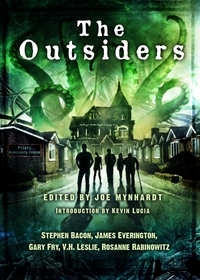
The Outsiders is a shared-world anthology which takes place in a small gated community in the UK called Priory, home to a cult that worships a colossal squid. Five different authors each contribute stories which fit together nicely. Each of our viewpoint characters are outsiders in some way either for being largely friendless, being black in a largely white neighborhood, being an unbeliever, or being gay in a religious community that frowns upon that. I felt like each story in the collection was better than the one before.

Continue reading

The Plague by Albert Camus

“There’s no question of heroism in all this. It’s a matter of common decency. That’s an idea which may make some people smile, but the only means of fighting a plague is – common decency.”

During the beginning of the Covid pandemic, The Plague by Albert Camus had a spike in popularity. I’m a bit late to jump on the bandwagon, but I’m glad I got around to reading it. Quotes from it, such as the one above, speak directly to our times, in which an act of common decency, such as wearing a mask, is the best way to fight disease.

Continue reading

The Word of the Lord by Harry Edgar Baker

There are three different texts titled The Word of the Lord used by different Mormon splinter groups. One was written by Otto Fetting between 1927-1933. Another was written by William Draves starting in 1933. However, I could find next to nothing online about about the text written by Harry Edgar Baker between 1916 to 1918. Wikipedia mentions the other two books sharing this title, but not this earlier one.

Continue reading

Noise by Daniel Kahneman, Olivier Sibony, and Cass R. Sunstein

55339408.jpg (258×400)

When it comes to errors in human judgment, we tend to focus on bias, but noise is also a cause of error. Bias is the average of errors committed by a group. You need to know the right answer to know what the bias is. Bias is systemic and predictable. Noise, on the other hand, is variable amongst a group of judgements. You can tell there’s noise even if you don’t know the right answer. It’s unpredictable and not easily explained.

Continue reading

I Have No Mouth & I Must Scream by Harlan Ellison

48677875._SY475_.jpg (312×475)

Harlan Ellison is considered one of science fiction’s grand masters and I’ve heard praise for the title story in this collection, so I decided to give it a try.

“I Have No Mouth & I Must Scream” doesn’t have much of a plot. Basically, four men and one woman are being tortured by an artificial intelligence the whole time. The woman has sex with all the men even though they beat her and ignore her cries.

Continue reading

The Black Vampyre by Uriah Derick D’Arcy

49567296._SY475_.jpg (268×475)

The Black Vampyre was written in response to Polidori’s Vampyre. The edition I read contained a fascinating introduction which provided context for the story and numerous footnotes which explain the now-obscure references in the story.

The Black Vampyre was written anonymously, attributed to one Uriah Derick D’Arcy (this is an anagram of Richard Varick Dey, who may have been the actual author). Like Polidori, the author quotes lines about vampires from Byron’s “The Giaour” which compared Greece being subject to the Ottoman Empire to slavery. D’Arcy takes up this theme, applying it to African slaves in America.

Continue reading

Enlightenment Now by Steven Pinker

35696171._SY475_.jpg (315×475)

The world is better today because of the Enlightenment, yet people attack reason, science, humanism, and progress when these things should be celebrated.

One of the bits of wisdom from the Scientific Revolution is that misfortune is no one’s fault. Bad things sometimes happen for no reason other than the universe is indifferent to human suffering. There’s no point looking around for someone to blame when an earthquake happens. Entropy ensures there’s more ways for things to go wrong than for things to go right.

Continue reading